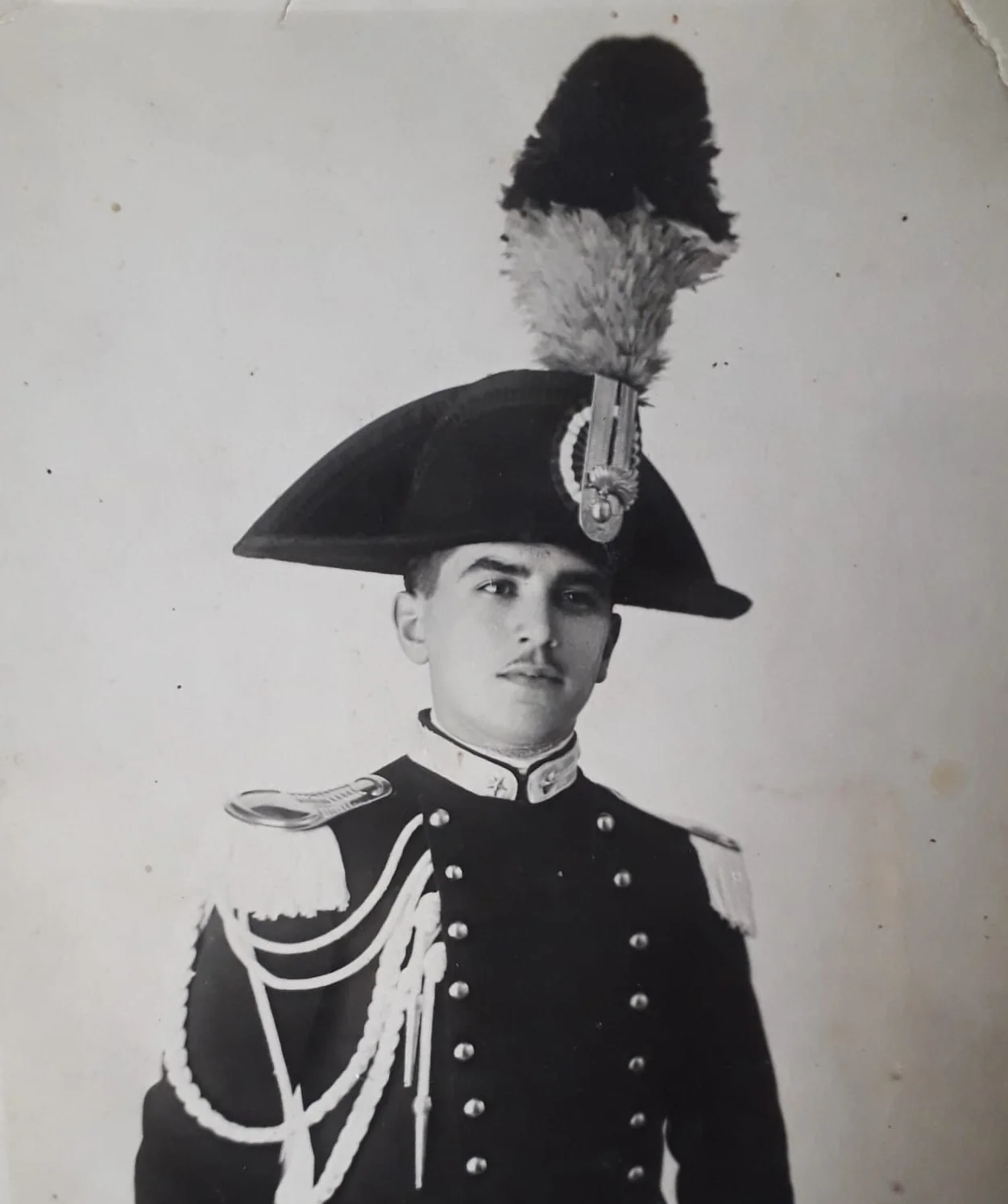
Pasquale Laporta Carabinieri Marshal

Pasquale Laporta

Carabinieri Marshal

Pasquale Laporta, a Marshal of the Carabinieri, had the courage to say loud and clear “No, sir!” more than half a century ago, when there was no protection other than the integrity of one’s commanding officers. Worth remembering at a time when obedience has curdled into servility, while insubordination passes for a right. A Corps that no longer exists, in an Italy that is disappearing.


We arrived on April 10, 1965, in the early hours of the afternoon. After the final climb between two walls of carved rock, there it was—San Giovanni Rotondo, spread out beneath Monte Nero, Monte Castellana, and Monte Calvo, the highest peak on the Gargano.

My father had been assigned to command the local Carabinieri station. I knew only some of what had led us there, and only part of the role played by General Giovanni de Lorenzo, Commander General of the Corps, in an Italy already destined for decline—a decline fully visible to everyone today.

Some time earlier, an officer from the high command in Bari had called my father to ask whether he “would be pleased” to go to the “town of Padre Pio”—those were his exact words—and leave his station in Latiano, in the Brindisi area of Salento. I am sure the unusual procedure did not particularly strike my father, even though in those days no one could conceive of a senior officer lowering himself to “ask” a marshal whether he “would be pleased” to carry out an order. My father, however, was deeply moved by the destination itself. He accepted on the spot. He had been to San Giovanni Rotondo on September 10, 1949, for his honeymoon. My mother reminded me of that often. He asked only to be transferred there after the birth of his fourth child, Maurizio, expected in February. It was easy to accommodate him, since the colleague he was to replace was retiring at the end of March.

When Latiano learned of my father’s departure, many expressed regret—no small number of them among those he had prosecuted over nine years: murder suspects, cattle thieves, jewelry thieves, prostitution rings, fraudsters, loan sharks, and parties to a string of shootouts, both among criminals and against the Carabinieri themselves. He had prosecuted, but never persecuted, applying the law with humanity.

Three bicycles guaranteed the mobility of the four Carabinieri under his command. On those bikes they patrolled day and night, through town and countryside, with no fixed hours. My father often went out alone at night, on his bicycle, armed with a 9mm Beretta, model 1934, reassuring my mother: “Don’t worry—nobody will shoot me in the back.” In the back, never. He was never ambushed, not even at night while discreetly checking here and there; nonetheless he was involved in half a dozen shootouts with criminals caught in the act. He slept with his submachine gun—a MAB 38—beside the nightstand; I managed to peek at it and touch it only twice, drunk with curiosity. No particular fear drove him to that company, as he told my mother, who was horrified; yet he could never know what to expect when a call came in the night and there was no time to retrieve a weapon from the armory.

The Corps Will Be Pulled Back to the Castle Walls

After six years in San Giovanni Rotondo, in 1970 I decided to apply the following year to the Military Academy in Modena, for the Carabinieri track. To surprise my father, I submitted the application to the Corporal on duty while he was out. A few hours later, he summoned me through that same Corporal. To understand the nature of our relationship: I addressed him as “you” the way one might address a superior. In his presence I felt like an open book, and he was a man of few words. “Sit down,” he said as I walked in, pointing to a chair in front of his desk. That was usually the ritual prelude to a dressing-down—neither brief nor calm. Instead, he spoke to me with a smile: “You’ve put in an application for Modena, for the Carabinieri track.” He studied me for a moment; was he about to compliment me? Did he welcome the surprise? “I know you very well,” he said deliberately. “You, as a Carabinieri officer, with that temperament of yours, will get yourself into trouble whose consequences you cannot even begin to imagine.” The smile disappeared. I had no time to reply: “And you should know that the Corps is no longer what you think it is. And it will get worse. The Corps will be pulled back to the castle walls”—his tone suddenly shifted, his voice rising—“and what happens outside those walls will be of absolutely no concern to anyone!” The word “no” was capitalized; startling, because profanity was anything but welcome to him. It was 1970, and nothing in my knowledge could have given the slightest meaning to those words, even though I knew my father never spoke carelessly—which only multiplied my uncertainty.

With time I came to understand that his closeness to Padre Pio—an intimacy he cultivated at every opportunity—had led him to ask the friar how to guide me. In that moment, however, I understood nothing, absolutely nothing, in bold capitals. What did my father mean by the Carabinieri “on the castle walls”? It was clear he did not want me to join the Corps, and that surprised me; yet the reason remained entirely opaque to me, like a vast and unsettling blackboard. We sat in silence for a moment. He was watching me; I could not read his expression. He was not angry—far from it—I could feel how much he cared for me.

I’m not sure whether it was Padre Pio himself—who watched me sternly from the photograph behind my father’s desk, above a portrait of Giuseppe Saragat and Enrico Mino, below the Crucifix—but I had a quick, uncharacteristic thought: “Come on, it’s your father, he loves you—listen to him.” As if he had heard me, he handed me the form I had already filled out. I took the pen from his hand, crossed out “Carabinieri,” and wrote “Various Arms.” My father nodded: “Good. For you and for me. In time you will understand.”

Why Did They Change the Oath?

I entered the Academy a few months later. The Carabinieri cadets’ company was an elite selection I could have joined with my eyes closed, given my standing in the entrance exam. Once again I asked myself why my father had stopped me. I chafed all the more under the command of a foolish captain from Viterbo who called everyone from Rome south “terrone”—a slur for southerners—and I never missed a chance to let him know exactly what I thought of him, which earned me punishment after punishment. I spent two rather difficult years at the Academy, perpetually disciplined thanks to my charming captain, and on the verge of resigning. But I refused to let that fool win, so I spent my evenings in the music room (with its excellent stereo and record collection) and in the library, where I began a serious study of the Soviet Union and Soviet military strategy. I enjoyed it enormously, but the assignment—forced on me in some measure by my father’s intervention—left a bitter aftertaste for a long time.

I was eventually assigned to the Corps of Engineers; the work thrilled me, and the regrets evaporated. On March 16, 1978, sometime around mid-morning, I was at the officers’ club of the Vittorio Veneto barracks in Motta di Livenza—a charming little town in the Treviso area, on the banks of the Livenza River, which gives the town its name. My captain and I were having coffee while our soldiers rested briefly from the bridge-laying exercise we were about to resume on the river.

The radio announced the kidnapping of Aldo Moro, and we were both stunned. We had repeatedly witnessed what security measures looked like around even the most minor undersecretary visiting the troops: armored vehicles and bodyguards wrapped around him as if he were behind enemy lines. How had it been possible to so easily abduct the de facto president-in-waiting, slated to succeed Giovanni Leone?

A further observation from my colleague struck me: “If they strike the President of the Senate, Amintore Fanfani, the Republic falls into the hands of the President of the Chamber, Pietro Ingrao—a Communist.”

I said nothing, but began preparing for the worst. In absolute secrecy, I drew up a simple but effective plan: identify the men, secure the weapons, ammunition, and explosives, and have everything ready to begin a resistance in the event of a coup. I had sworn an oath to the Republic; I was—and remain—bound by it.

On July 11, 1978, two months after the assassination of Aldo Moro, Law No. 382 was enacted—the “Principle Rules on Military Discipline”—altering the oath formula and dismantling the Military Disciplinary Code of 1964, a small masterpiece that had genuinely protected the dignity of servicemen. Until Law 382/78, one swore “loyalty to the Italian Republic and to its Head of State”; afterward, one swore “loyalty to the Constitution”—that is, to whoever happened to be in power. Was this a prelude to a coup? My alarm grew. Nothing apparently happened; I gradually calmed down. From that moment on, I never lost sight of the circles that had emerged from Aldo Moro’s death onward. I refreshed my studies of Marx, Lenin, and Stalin, and of the Soviet Spetsnaz—as I had begun doing on my own in Modena, to “study the enemy”—keeping myself occupied in the vast and well-stocked library on the evenings my beloved captain, with generous consistency, punished me and denied me leave. I bought and studied a notorious book of the time: “In Case of a Coup d’état: A Guerrilla Manual,” published by the communist Savelli press. “Fight the enemy with his own weapons,” I thought—and stayed on alert.

A People Crushed Between Landowners and Corrupts

That summer I had no chance to speak with my father because we did not take a vacation; I had the conversation instead the following year, when he had been retired for two years. It turned to Aldo Moro, and I told him about the exchange I’d had on March 16—without revealing my heroic neo-partisan plans. He looked at me with evident pain, his sad smile unforgettable: “You see I was right?” Once again I did not fully understand: “They killed General Enrico Mino, they sidelined General de Lorenzo and then General Vito Miceli, then they killed Moro after isolating him completely. Without the complicity of senior figures inside the Corps, it would have been impossible.” The words he had spoken the day I submitted my Academy application came back to me, and I began to connect the pieces. We had a long conversation—long, at least, by his standards, since he was rather sparing with words.

I finally asked him why, at the end of September 1963, I had been left behind. He had been transferred from Latiano to Iglesias, in Sardinia, within a single day—today that seems unimaginable; back then it happened precisely that way: we received the news in the morning before lunch. The following day my father left for Iglesias. I had just started the school year and there was no time to arrange enrollment elsewhere. In any case, where? In Iglesias? I was placed with a kind woman, and they all disappeared within hours: my father to Sardinia; my mother, my brother Giuseppe, and my sister Anna went to Putignano, guests of Aunt Maria and Uncle Ciccio, two unforgettable figures—two guardian angels.

To be clear: I was the only one delighted by that family upheaval. I was not yet fourteen, left on my own, looked after by Angela, a wonderful woman who made sure I lacked for nothing and did not keep too close an eye on me; I was intoxicated with freedom.

My father had never given me details about what happened. But that day in 1979, he opened up. Latiano lived on agriculture—grapes, tobacco, wheat, almonds, and dried figs—with its attendant artisan trade. Power rested with the “beati possidentes”—a small number of local notables, as was common in southern towns at the time, and to a considerable extent still today. To escape, there were four or five paths: land a government job, emigrate to work at Fiat or abroad, become an entrepreneur, become a criminal, or both. The labor shortage caused by emigration should have made life easier for the farmhands who remained. It did not, not at all. The machine that ground down the poor was explained to my father by a cobbler, Luigi Zacheo, secretary of the local Italian Communist Party chapter. My father was supposed to monitor him because a Carabinieri circular required it, as he was a prominent Communist activist. He was above all a sharp mind and an honest person, my father certified. Everything revolved, Zacheo explained, around credit that slid into usury, enslaving entire families to “caporali”—labor bosses—behind whom stood notables with clean hands. A farmhand, to find work, surrendered part of his wage to the caporale; the amount was set by the caporale himself, without negotiation, calibrated to undercut any rival boss who might be more profitable for the landowner. When that happened, there were brawls, stabbings, and shootings in what people called the “piazza del sangue”—the square of blood—where today a statue stands to commemorate Blessed Bartolo Longo. Alongside the caporalato ran freelance crime: prostitution, theft, extortion, robbery, often degenerating into murder, not excluding the occasional alliance of convenience with one powerful faction or another.

The cobbler was not a spy or an informer; he helped my father read the events unfolding around him. There were plenty of informers among the criminals, who were inclined to wage war on one another. The priority was prevention—a firm hand with repeat offenders and, above all, stopping troubled young men from being recruited into criminal organizations. My father did not play dirty. Honesty and loyalty were non-negotiable for him. No one was ever tortured under his watch, as happened and still happens. No one was ever set up with fabricated evidence, as happened and still happens. Everything went more or less well until the summer of 1963.

A Burned Door Announces a Storm

After my middle-school exams, I was waiting for the end of July to go to Putignano, to Aunt Maria and Uncle Ciccio’s trulli. I waited in vain, along with my siblings; the tension at home was so thick you could cut it with a knife, and we children could not understand why.

My father unexpectedly suggested I spend two weeks at the Stella Maris summer camp in Campomarino, on the Ionian Sea. It had been founded and was run by the unforgettable parish priest of the local church, Don Giovanni Mauro, and was available in summer to young members of Catholic Action and to the needy. We were about thirty boys and had a wonderful time—a gorgeous sea, wholesome food, boisterous games, and daily prayers. By evening we arrived exhausted, collapsing onto our beds. One of the last nights, however, I lay awake with the window open, through which the two Catholic Action delegates who supervised us were having a conversation outside. I sensed they were talking about my father; I strained to listen and clearly heard one of them say: “We will get Marshal Laporta transferred, since he refuses to understand.” When I returned home, I tore up my Catholic Action membership card and told my father. He asked for the name of the one who had spoken and said nothing more. As I already mentioned, two weeks after starting high school, my father was transferred to Iglesias within twenty-four hours.

“Why were you transferred to Sardinia?” I finally asked, after so many years, knowing this time he would answer me.

One of Latiano’s criminals had severely intimidated four farmhands who were causing problems for a local notable who was not paying their wages. The unfortunate men had finally bowed to the threats of T***. Everyone in town knew how it had gone; no one was filing a complaint or coming forward as a witness. What is more, the notable—notorious for his tightfistedness—had not paid T*** the full agreed amount for the dirty work, so T*** cleaned out one of his farmhouses and cut down three fairly young olive trees. There were countless centuries-old trees on the property, and the warning was clear: if you don’t pay, I’ll cut down the rest.

The notable showed up at the station demanding that my father act against T***. He obviously said nothing of the background and produced no evidence. My father conducted an investigation; he identified a couple of farmhands who knew the details but made no admissions, letting him understand only in confidence what had occurred. The threatened farmhands admitted to the facts, but no one would sign anything; each insisted on speaking with my father alone, without witnesses.

My father dragged his feet; it was not easy to persuade people to talk, and he was inclined in the end to let the matter drop. Rumors were not evidence, and the facts presented by the complainant were plainly missing too much truth. He drafted his report for the magistrate and his command. The complaining notable found out, returned to the station in protest, and left with a warning: “We’ll talk again soon!”

Two nights later, the front door of our home was badly burned. A carpenter across from the station, known as Mestru Llucciu, was called in; the door was repaired. My father paid the craftsman and said nothing. He said nothing to his superior command, which had evidently informed the landowner about the complaint.

A lieutenant appeared at the station. He was well aware of the damage to the door and of the whole affair; he was even informed of the existence of two new witnesses: “And why haven’t you identified them?” My father did not hesitate: “Because they are false witnesses.” The lieutenant ignored this: “That’s not your concern. I am ordering you to arrest T*** and make him confess by any means necessary.”

“No, sir.”

“What did you just s—? Did I hear you correctly? Obey!”

“You heard perfectly, Lieutenant: No. Sir. As long as I command here, we do not do things like that.”

My father’s office was separated from our family’s kitchen only by a door. We heard the lieutenant screaming like a madman: “You will do what I order, or I’ll have you shipped off to Sardinia!” My mother had gone white; I could not understand what was happening.

A few days later the order arrived: my father was to “immediately” surrender command of the station to his corporal and depart the following day for Iglesias. Minutes after he read the transfer order, the lieutenant called: “So—have you changed your mind?” My father did not let him finish: “No, sir”—and hung up the phone.

An unforgettable whirlwind began, for which my father seemed oddly prepared. A Fiat 1800 arrived; he first drove me to Francavilla Fontana, to Angela. The same car then took my mother, my sister Anna, and my brother Pino to Putignano, to Aunt Maria and Uncle Ciccio’s house. The next day my father traveled to Brindisi, then to Bari, then to Rome, then to Civitavecchia, and finally boarded the ferry to Sardinia and continued on to Iglesias.

In Front Of General de Lorenzo

Communications among us depended entirely on telephone—still rather primitive in those days. Then things went from bad to worse. My sister was admitted shortly afterward to the Bari polyclinic with a very serious illness. My mother, pregnant, made constant trips between Putignano and Bari. She bombarded the Carabinieri Legion in Bari with daily calls. Her contacts there kept soothing her with empty words. My mother knew the details of the dirty affair and threatened every day to expose them to the press. My father had expressly forbidden her to do so—the Corps must not be tarnished because of scoundrels—and so my mother’s threats, however alarming at first, soon proved as futile as her desperate phone calls. Her interlocutor went on placating her without giving her a second thought.

My father had requested an audience at every level of the chain of command. Before going to the final authority, he called me and asked me to relay a message to the lieutenant: it was pointless to keep him in Iglesias, because what the lieutenant wanted done would never happen—my father would testify in court.

I remember repeating the words my father had dictated to me several times, having written them down to relay them faithfully, even though I did not fully grasp them.

The lieutenant received me with the condescension befitting a small boy. I delivered my father’s message; he was briefly taken aback, then dismissed me: “Your father stays in Sardinia.”

My father requested an audience with the Commander General of the Corps, Giovanni de Lorenzo. Several weeks passed and then the summons arrived to Rome, where he arrived the previous day after disembarking at Civitavecchia. Early in the morning he presented himself at Viale Romania, where the Corps General Command has its headquarters. The appointment was at eleven, but he refused to risk being even a minute late. At eleven o’clock sharp he entered the Commander’s office.

“It was an enormous office. De Lorenzo was standing, wearing his monocle, the fingertips of both hands resting on the desk. After I introduced myself, he said only one word: ‘Speak.’” My father recounted this as though he had relived the scene a thousand times. “As I spoke, I felt reassured—he had a stern but honest face. I noticed among his decorations one that matched mine; we had both fought in the Russian campaign. I felt at ease; while the aide-de-camp took notes, I laid out all the facts, the names, the circumstances. I told him how I had been transferred to Sardinia. I made a brief mention of your mother’s condition and Anna’s—only a brief mention. I was detailed on the facts and the individuals—nothing more. I also relayed the message I had entrusted to you for the lieutenant.” My father smiled cheerfully. “He dismissed me with a nod of his head, without a word, without a sound—not a single muscle in de Lorenzo’s face moved. All the confidence I had felt at the start vanished; I was convinced I had hit another dead end—the final one, sealing disaster for the family, for me, and for all of you.”

After Despair, Justice

My father continued to smile as he described his despair, which left me slightly dazed: “The return journey was hellish. I didn’t sleep a wink, asking myself what would become of me and all of you. I was desperate; Anna in the hospital, your mother expecting Maurizio, Pino with the aunts and uncle, you in Francavilla.” He repeated “I was desperate” many times, then said with an unforgettable smile: “If I hadn’t had faith in God, I would have killed myself. Through the entire night I prayed, calling on Padre Pio, while I was tempted to throw myself off the ferry.” And he continued, inexplicably, to smile. “When I arrived in Iglesias and went to my room, there was an envelope on the bed: I was ordered to return ‘immediately’ to Latiano, resume command of the station, and await a new assignment.” At that point we were both laughing: “I went down on my knees to thank Almighty God, who had heard my prayers. When I reached Latiano, the lieutenant had already left for Iglesias. I can’t be certain, but I believe our ferries crossed paths.”

De Lorenzo had put the entire chain of command on the boil. Confirmation came a few days later in the form of a honeyed phone call from the head of personnel, asking him: “Would you be pleased to go to the town of Padre Pio?” It was the same officer who had repeatedly strung my mother along.

“When the SIFAR–de Lorenzo scandal broke, I didn’t know what to think. In August 1968, a month before Padre Pio died, an officer from the general command asked me to help arrange a meeting with Padre Pio; he was anguished, deeply anguished. We were both witnesses to extraordinary events when Padre Pio assured him of his protection. He confided to me what was happening inside the Corps and was convinced it was an unstoppable decline. He confirmed to me that General Giovanni de Lorenzo was a man of honor.” My father then shared with me what he had been told, after I gave him my word not to reveal it. I could not have imagined how useful it would prove for “reading” reality without prejudice, when I later found myself at the Military Policy Office of the Defense General Staff.

⁂    ⁂    ⁂

And yet, despite all he had told me, I was still convinced that my father had overreacted in discouraging me from joining the Corps. Of course I held nothing against him—he had done it for my own good, after all—but still, he had overreacted.

It took years to understand that he had done it for my good and that, no, he had not overreacted at all. Everything he told me is coming to pass. Day after day we have seen commanders conspire to seize power at any cost. We have seen Marshal Antonino Lombardo, driven to suicide and forgotten like a dog on a highway. We have seen commanders genuflecting before anti-mafia campaigns that reek of the same perfect symmetry that Ennio Flaiano and Mino Maccari denounced in fascism and anti-fascism alike. We have seen commanders who claimed not to know that Stefano Cucchi had been tortured, offloading responsibility onto the most marginal members of a broken-down cart. We have seen commanders review their troops while led on a leash by a corporal from the co-determination committee. We have seen commanders indignant because the unions got involved, forgetting the miserable quality of their own command. We have seen commanders ignore the suicides of Carabinieri. We have seen commanders shirk moral responsibility for sexual violence committed by non-commissioned officers whose sense of honor and discipline perfectly mirrors the decadence in the upper ranks. We have seen commanders look the other way in the face of homicides.

We have seen commanders order raids on churches, trampling the laws and the Constitution to which they swore an oath. We have seen commanders express solidarity with a general whose past is shrouded in darkness, and fall silent before the house arrest at the beach of an American murderer who gutted Carabinieri Corporal Cerciello like an animal. This long list of outrages must be updated frequently, enriched by episodes ever more disgusting than those before.

These filthy acts are justified with the last refuge of scoundrels: rhetoric. “We are trained to obey in silence” and “we risk our lives”—neglecting to add “the lives of others.” For never have so many Carabinieri been seen on the streets, with helicopters, as in these days of constitutional outrages; never have so many been seen raiding drug distribution points, protecting homes violated by murderous thieves and robbers. Never have commanders been seen defending the work of their own men—work undone by lax judges.

The Corps’ motto “Faithful Through the Centuries” demands a question: Faithful to whom?

My father, if anyone ventured to say “Carabinieri and Police,” would cut them off abruptly, whoever they might be: “We are not the same thing: the police answer to the Government; the Carabinieri answer to the State.” Today the Carabinieri are pulled back to the castle walls, defending those who insult the Constitution, standing shoulder to shoulder with the State Police—which, all things considered, has at least always been consistent in its role as a government instrument. What are we to conclude but that we have a pointless duplication of police forces? “Divide and rule?” Come now, let us be serious: the zeal of both sides could only be doubled by merging them, while saving what is being squandered. Is this truly what the real Carabinieri want—those still existing and still at work, who in silence perform and wish to perform their duty to the fullest, whatever the cost, just as my father did?

It may happen that circumstances bring an officer before the choice of whether or not to betray his oath of loyalty. In such a case, it would be desirable for those responsible to have the decency to follow the example of Commander Carlo Fecia di Cossato—a dignity nonetheless recovered by countless ordinary Carabinieri who took their own lives, innocent and dignified victims to whom our respectful thoughts go.

Commanders, if you are incapable of restoring the spirit of the Corps beyond empty rhetorical displays, if you cannot put a bullet in your own temple, at least fill out a resignation letter and retire with a generous pension. That would be the desirable course of action for the good of the Fatherland, the Constitution, and whatever remains of the Corps—now perfectly ready to merge with the State Police, doubling the zeal of that ramshackle Italian constabulary.


Pasquale Laporta, Maresciallo dei Carabinieri

Pasquale Laporta, maresciallo dei Carabinieri, seppe dire alto e forte «Signornò!» oltre mezzo secolo fa, quando non v’era altra tutela se non la rettitudine dei Comandanti. Giusto ricordarlo quando l’obbedienza è trascolorata in servilismo, mentre l’insubordinazione appare un diritto. Un’Arma che non c’è più in un’Italia che scompare.

Arrivammo il 10 aprile 1965, nelle prime ore del pomeriggio. Dopo l’ultima salita fra due pareti scavate di roccia, ecco San Giovanni Rotondo, distesa sotto Monte Nero, Monte Castellana e Monte Calvo, la cima più alta del Gargano.

Mio padre andava a comandarvi la stazione dell’Arma. Conoscevo solo alcuni degli eventi che vi ci conducevano e della parte avutavi dal Generale Giovanni de Lorenzo, Comandante generale dell’Arma, nell’Italia destinata al declino, oggi sotto gli occhi di tutti.

Un ufficiale dell’alto comando di Bari telefonò tempo prima a mio padre per chiedergli se gradiva andare nel «paese di padre Pio», disse proprio così, per lasciare la stazione di Latiano, nel Salento brindisino. L’inconsueta procedura sono certo non colpì mio padre, sebbene a quei tempi non si concepisse un alto ufficiale abbassarsi a «chiedere» addirittura a un maresciallo se «gradiva» eseguire un ordine. Mio padre fu invece molto colpito dalla destinazione. Accettò all’istante. A San Giovanni Rotondo vi era andato il 10 settembre 1949 in viaggio di nozze. Mia madre me lo ricordava sovente. Mio padre chiese solo di potervisi trasferire dopo il parto dell’ultimo dei quattro figli, Maurizio, atteso per febbraio. Fu facile accontentarlo perché il collega da avvicendare si congedava a fine marzo.

Quando Latiano seppe della partenza di mio padre, numerosi espressero rammarico, non pochi fra quanti aveva perseguito in nove anni, fra omicidi, furti di animali e di preziosi, prostituzione, truffe, usura e una quantità di sparatorie, tanto fra delinquenti quanto contro i carabinieri. Aveva perseguito ma mai perseguitato, applicando umanamente la legge.

Tre biciclette garantivano la mobilità dei quattro carabinieri ai suoi ordini. Col velocipede perlustravano notte e giorno, paese e campagne, senza limiti di orario. Mio padre andava sovente da solo di notte, in bici, con la Beretta calibro 9, modello 1934, rassicurando mia madre: «Stai tranquilla, nessuno mi sparerà alle spalle». Alle spalle, mai. Non subì mai un agguato infatti, neppure di notte, controllando discretamente qui e là; non di meno ebbe una mezza dozzina di sparatorie coi malandrini colti sul fatto. Dormiva col mitra, il MAB 38, accanto al comodino; potei sbirciarlo e toccarlo solo un paio di volte, ebbro di curiosità. Non furono timori particolari a indurlo a tale compagnia, come disse a mia madre che inorridiva; non poteva tuttavia sapere che cosa aspettarsi quando lo chiamavano di notte e non v’era tempo di dotarsi nell’armeria.

L’ARMA SARÀ RITIRATA SULLE MURA DEL CASTELLO

Dopo sei anni a San Giovanni Rotondo, nel 1970 decisi di entrare l’anno successivo nell’Accademia militare di Modena, nel corso per i Carabinieri. Per fare una sorpresa a mio padre, consegnai la domanda al Brigadiere, mentre egli era assente. Qualche ora dopo mi mandò a chiamare attraverso lo stesso Brigadiere. Per comprendere quale fosse il nostro rapporto, gli davo del tu come se gli dessi del lei. Di fronte a lui mi sentivo come un libro aperto ed egli era di poche parole. «Siediti» disse mentre entravo, indicandomi una sedia davanti alla sua scrivania. Era un rituale di solito preludio d’una lavata di capo né breve né tranquilla. Mi parlò invece sorridendo: «Hai fatto domanda per Modena, per il corso Carabinieri». Mi squadrò per alcuni istanti; stava per complimentarsi? Gradiva la sorpresa? «Io ti conosco molto bene» scandì «Tu, carabiniere, col tuo carattere, ti cacci in un guaio, le cui conseguenze non puoi neppure immaginare». Il sorriso scomparve. Non ebbi tempo né modo di replicare: «E devi sapere che l’Arma non è più quella che immagini. E sarà ancora peggio. Sarà ritirata sulle mura del castello» improvvisamente il suo tono mutò, alzò la voce «e di quanto accadrà fuori dalle mura non importerà nulla a nessuno!» «Nulla» era con la C maiuscola; sorprendente perché il turpiloquio non gli era gradito, tutt’altro. Era il 1970, non c’era nulla nelle mie conoscenze che potesse minimamente dare significato a quelle parole, sebbene sapessi che mio padre non parlava a vanvera e questo aumentava esponenzialmente la mia incertezza.

Col tempo capii che la sua dimestichezza, un’assiduità coltivata ogni volta che aveva occasione con Padre Pio, l’avessero indotto a chiedere al Frate come instradarmi. In quel momento tuttavia non capii niente, proprio nulla, con una C ancor più maiuscola e in grassetto. Che cosa intendeva mio padre coi carabinieri «sulle mura del castello»? Non gradiva andassi nell’Arma, ne fui sorpreso e tuttavia questo mi fu chiaro; allo stesso tempo mi era del tutto oscura la ragione, come una lavagna nera, vasta e inquietante. Rimanemmo qualche istante in silenzio. Egli mi scrutava; non riuscivo a decifrarne lo sguardo. Non era arrabbiato, tutt’altro, percepivo quanto mi voleva bene.

Non so se fu proprio Padre Pio – mi osservava arcigno dalla foto alle sue spalle, sopra a Giuseppe Saragat ed Enrico Mino, sotto al Crocefisso – quand’ebbi un rapido pensiero, inusuale per il mio carattere: «Dai, è tuo padre, ti vuole bene, ascoltalo». Come avesse udito, mi porse il modulo che avevo già compilato. Presi la biro dalle sue mani, cancellai «Carabinieri» e scrissi «Varie Armi». Mio padre annuì: «Hai fatto bene, per te e per me. Col tempo mi capirai.»

PERCHÉ CAMBIARONO LA FORMULA DI GIURAMENTO?

Entrai in Accademia pochi mesi dopo. La compagnia allievi Carabinieri era una selezione elitaria, alla quale avrei potuto accedere a occhi chiusi, essendo ai primi posti del concorso. Ancora una volta mi chiesi perché mio padre me l’avesse impedito, sconsigliato; tanto più mi rodevo, agli ordini d’uno sciocco capitano di Viterbo, che dava del terrone a quelli da Roma in giù; io non perdevo occasione per fargli intendere quanto lo stimassi e quello mi puniva. Passai insomma due anni alquanto problematici in Accademia; ero sempre punito grazie al mio simpatico capitano e avrei voluto dare le dimissioni, lasciando l’Accademia. Non volli però darla vinta a quello sciocco e trascorsi le mie serate fra la sala musica (col suo impianto stereo e vinili di superba qualità) e la biblioteca, dove cominciai a studiare a fondo l’Unione sovietica e la strategia militare sovietica. Mi piaceva molto ma la scelta, in qualche misura impostami da mio padre, lasciò a lungo un retrogusto amaro. Fui assegnato infine all’Arma del Genio, il lavoro m’entusiasmò e i rimpianti svaporarono.

Il 16 marzo 1978, intorno a mezza mattinata ero al circolo ufficiali della caserma Vittorio Veneto di Motta di Livenza, delizioso paesotto trevigiano, sulle rive del fiume Livenza, da cui prende il nome. Io e il mio capitano prendevamo il caffè, mentre i nostri soldati godevano un po’ di riposo nell’addestramento col ponte che avremmo gittato di lì a poco sul fiume.

La radio annunciò il rapimento di Aldo Moro e stupimmo ambedue. Avevamo più volte constatato cosa fossero le misure di sicurezza attorno a un qualsiasi sottosegretario piccolo a piacere, in visita ai reparti: auto blindata e guardie del corpo a cinturalo come fosse fra nemici. Com’era possibile rapire facilmente il presidente della Repubblica in pectore, destinato a succedere a Giovanni Leone?

Un’ulteriore osservazione del mio amico mi colpì: «Se fanno un attentato al presidente del Senato, Amintore Fanfani, la Repubblica è nelle mani del presidente della Camera, Pietro Ingrao, comunista».

Non dissi nulla, preparandomi tuttavia al peggio. Approntai in assoluto segreto un piccolo, semplice ma efficace piano per selezionare gli uomini, prendere le armi, le munizioni, gli esplosivi e il necessario per cominciare la resistenza in caso di colpo di Stato. Giurai fedeltà alla Repubblica, ne ero e ne sono vincolato tuttora.

L’11 luglio 1978, due mesi dopo l’assassinio di Aldo Moro, fu promulgata la legge n. 382, «Norme di principio sulla disciplina militare», modificando la formula di giuramento e smantellando il Regolamento di Disciplina Militare edizione 1964, un piccolo capolavoro che tutelava davvero la dignità dei militari. Fino alla legge 382/78 si giurò «fedeltà alla Repubblica italiana e al suo Capo», dopo si giurò «fedeltà alla Costituzione», cioè a chi aveva preso il potere. Era un preludio di colpo di Stato? Il mio allarme crebbe. Non accadde apparentemente nulla; man mano mi tranquillizzai. Da quel momento non persi più di vista le cerchie venute allo scoperto dalla morte di Aldo Moro in avanti. Rinfrescai i miei studi su Marx, Lenin e Stalin, sugli spetsnaz, come avevo cominciato a Modena per conto mio, per «studire il nemico», tenendomi occupato nella vasta e munitissima biblioteca, nelle sere in cui il mio amato capitano mi puniva con generosa assiduità, impedendomi di uscire. Acquistai e studiai un libro allora famigerato: In caso di golpe. Manuale di guerriglia, della editrice Savelli, comunista. «Combattere il nemico con le sue armi», pensai e rimasi in allerta.

POPOLO PESTATO FRA SIGNOROTTI E CORROTTI

Q

uell’estate non ebbi modo di parlare con mio padre perché non ci recammo in vacanza, come invece l’anno successivo, quando egli era in pensione da due anni. Il discorso cadde su Aldo Moro e gli raccontai del colloquio avuto quel 16 marzo, senza svelare i miei eroici piani da neo partigiano. Mi guardò con sofferenza evidente, indimenticabile il mesto sorriso: «Hai visto che avevo ragione?» Ancora una volta non capivo: «Hanno ucciso il generale Enrico Mino, hanno messo nell’angolo prima il generale De Lorenzo e poi il generale Vito Miceli, poi hanno ucciso Moro, dopo avergli fatto il vuoto intorno. Senza la complicità di papaveri dell’Arma sarebbe stato impossibile». Mi tornò in mente quanto disse il giorno in cui presentai la domanda per l’Accademia e cominciai a collegare. Iniziammo un lungo colloquio, lungo per quanto era possibile con lui, alquanto avaro di parole.

Gli chiesi finalmente perché a fine settembre del 1963, io ero rimasto solo. Egli fu trasferito da Latiano a Iglesias, in Sardegna, nel volgere d’un giorno; oggi pare incredibile; allora accadde proprio così: avemmo la notizia al mattino prima dell’ora di pranzo. Il giorno successivo mio padre partì per Iglesias. Avevo iniziato l’anno scolastico e non c’era il tempo materiale per organizzare l’iscrizione in un altro istituto. D’altronde dove? A Iglesias? Mi affidarono a una brava signora e scomparvero nel volgere di poche ore: mio padre in Sardegna; mia madre, mio fratello Giuseppe e mia sorella Anna andarono a Putignano, ospiti di zia Maria e zio Ciccio, due indimenticabili personaggi, due angeli custodi.

Intendiamoci, io fui l’unico felicissimo per quel cataclisma in famiglia. Avevo meno di 14 anni, rimasto solo, accudito da Angela, bravissima donna che non faceva mancare nulla e per giunta non mi controllava più di tanto; ero inebriato di libertà.

Mio padre non mi aveva mai dato dettagli sulla vicenda. Quel giorno del 1979 invece s’aprì. Latiano viveva d’agricoltura, uva, tabacco, grano, mandorle e fichi seccati, accodandosi l’indotto artigianale. Il potere era in mano ai beati possidentes, pochi notabili, com’accadeva nelle cittadine meridionali a quel tempo e in buona misura ancor oggi. Per sfuggire c’erano quattro o cinque modi: accaparrare un impiego pubblico, emigrare verso la Fiat o verso l’estero, diventare imprenditore o delinquente, oppure ambedue. La penuria di manodopera, causata dall’emigrazione, avrebbe dovuto rendere più facile la vita al bracciantato rimasto. Non fu affatto così. La macchina che stritolava la povera gente fu illustrata a mio padre da un ciabattino, Luigi Zacheo, segretario della locale sezione del Partito Comunista Italiano. Mio padre doveva controllarlo perché così era previsto da una circolare dei Carabinieri, in quanto era un attivista comunista di primo piano. Era soprattutto una mente acuta e una persona onesta, certificò mio padre.

Tutto ruotava, spiegò, intorno al credito trascolorante in usura, schiavizzando intere famiglie ai «caporali», dietro i quali c’erano i notabili dalle mani pulite. Il bracciante per lavorare cedeva al caporale una parte di salario, il cui ammontare, imposto dallo stesso caporale, senza possibilità di trattativa, doveva equilibrarsi tenendo conto che il padrone poteva assumere un altro caporale più profittevole. Quando accadeva questo, erano risse, accoltellamenti e sparatorie nella «piazza del sangue», dove oggi domina una statua a commemorare il beato Bartolo Longo. Al caporalato s’affiancava la delinquenza fuori sistema: prostituzione, furti, estorsioni, rapine, sovente degeneranti in omicidio, senza escludere d’aggiogarsi di volta in volta a un potentato o all’altro.

Il ciabattino non era una spia o un confidente; aiutava mio padre a leggere nei fatti che accadevano. Di confidenti ve n’era numerosi fra i delinquenti, inclini a farsi guerra l’un l’altro. Occorreva innanzi tutto prevenire, usare il pugno duro coi recidivi e soprattutto impedire ai giovani sbandati di farsi arruolare. Mio padre non giocava sporco. L’onestà e la lealtà gli erano irrinunciabili. Mai nessuno fu torturato da mio padre, come invece accadeva e accade. Mai nessuno fu incastrato con prove false, come accadeva e accade. Tutto andò più o meno bene fino all’estate del 1963.

UN PORTONE BRUCIATO ANNUNCIA TEMPESTA

Conclusi gli esami di terza media, aspettavo la fine di luglio, per andare a Putignano, nei trulli di zia Maria e zio Ciccio. Aspettai invano coi miei fratelli; la tensione in casa si tagliava col coltello e noi ragazzi non capivamo il perché.

Mio padre mi propose inaspettatamente di passare due settimane nella colonia marina Stella Maris, a Campomarino, sul mar Ionio, fondata e gestita dall’indimenticabile parroco della Chiesa madre, don Giovanni Mauro, a disposizione in estate per i giovani dell’Azione Cattolica e per i bisognosi. Eravamo una trentina di ragazzi e ci divertivamo moltissimo fra mare incantevole, cibo sano, giochi schiamazzanti e preghiere quotidiane. A sera s’arrivava sfiniti, crollando sui letti. Una delle ultime notti invece rimasi sveglio, con la finestra aperta, fuori dalla quale i due delegati dell’Azione Cattolica, nostri sorveglianti, stavano conversando. Percepii che parlavano di mio padre, drizzai le orecchie e sentii chiaramente uno dei due: «Il maresciallo Laporta lo faremo trasferire, visto che non vuole capire». Quando tornai a casa, stracciata la tessera dell’Azione Cattolica, riferii a mio padre. Egli mi chiese il nome del sibilante e non commentò. Come ho già detto, due settimane dopo aver iniziato la prima superiore, mio padre venne trasferito a Iglesias nel giro di ventiquattro ore.

«Perché fosti trasferito in Sardegna?» chiesi finalmente dopo tanti anni, sapendo che questa volta mi avrebbe risposto.

Uno dei delinquenti di Latiano fece una pesante intimidazione a quattro braccianti che creavano problemi a un notabile perché non pagava i salari. I poveretti s’erano piegati infine alle minacce di T***. Tutti in paese sapevano com’era andata; nessuno denunciava né testimoniava. Per di più il notabile, noto spilorcio, non dette tutto il pattuito per gli sporchi servigi di T***, il quale gli vuotò una delle masserie, tagliandogli anche tre ulivi abbastanza giovani. Ve n’erano innumerevoli secolari e l’avvertimento era chiaro: se non paghi taglio anche i rimanenti.

Il notabile si presentò in caserma, esigendo che mio padre agisse contro T***. Non raccontò ovviamente l’antefatto e non fornì alcuna prova. Mio padre fece un sopralluogo; individuò un paio di contadini che sapevano i dettagli ma non fecero alcuna ammissione, lasciando intendere solo confidenzialmente che cosa fosse accaduto. I braccianti minacciati da T*** ammisero i fatti ma nessuno firmò alcunché, anzi ciascuno volle parlare solo con mio padre, senza altri testimoni.

Mio padre la tirò per le lunghe; non era facile convincere le persone a parlare ed era infine propenso a lasciar cadere la questione. Le dicerie infatti non erano prove e i fatti esposti dal denunciante erano palesemente carenti di verità. Stilò il suo rapporto per il magistrato e per il suo comando. Ne venne a conoscenza il notabilotto denunciante, il quale andò a protestare in caserma e si congedò bellicoso: «Ne riparliamo presto!»

Due notti dopo il portone della nostra casa fu malamente bruciato. Chiamato mestru Llucciu, il falegname di fronte alla caserma, il portone fu riparato. Mio padre pagò l’artigiano e non commentò. Non disse alcunché al comando superiore che aveva evidentemente informato il possidente circa la denuncia.

Piombò in caserma un tenente, ben a conoscenza dei danni al portone e dei fatti, anzi addirittura informato dell’esistenza di due nuovi testimoni: «E tu come mai non li hai individuati?» Mio padre non esitò: «Perché sono falsi testimoni». Il tenente non se ne dette per inteso: «Tu non preoccuparti di questo. Io ti ordino di arrestare T*** e farlo confessare in un modo o nell’altro».

«Signornò.»

«Come hai detto? Ho capito bene? Obbedisci!»

«Ha capito benissimo, signor tenente: si-gno-r-nò! Finché comando io qui, queste porcherie non si fanno».

L’ufficio di mio padre era diviso dalla cucina del nostro alloggio solo da una porta. Sentimmo il tenente urlare come un ossesso: «Tu fai quello che ti ordino, altrimenti ti sbatto in Sardegna». Mia madre era livida, io non capivo che cosa stesse accadendo.

Dopo pochi giorni giunse l’ordine: mio padre doveva «immediatamente» lasciare il comando della stazione al suo Brigadiere e partire il giorno successivo per Iglesias. Dopo pochi minuti dalla lettura dell’ordine di trasferimento, il tenente telefonò: «Allora, hai cambiato idea?» Mio padre non lo fece neppure finire: «Signornò» e mise giù il telefono.

Iniziò un turbinio indimenticabile, per il quale mio padre sembò tuttavia alquanto preparato. Arrivò una Fiat 1800; prima accompagnò me a Francavilla Fontana da Angela. Con la stessa auto mia madre, mia sorella Anna e mio fratello Pino furono condotti a Putignano a casa di zia Maria e zio Ciccio. Mio padre il giorno successivo si recò a Brindisi, da lì a Bari, quindi fino a Roma, poi a Civitavecchia, infine il traghetto per la Sardegna e proseguì sino a Iglesias.

DI FRONTE AL GENERALE DE LORENZO

Le comunicazioni fra noi erano affidate solo al telefono, alquanto primitivo a quei tempi. Piovve sul bagnato. Mia sorella dopo poco tempo fu ricoverata per una malattia molto seria nel policlinico di Bari. Mia madre, incinta, faceva la spola fra Putignano e Bari. Essa tempestava ogni giorno di telefonate la Legione Carabinieri di Bari. I suoi interlocutori la blandivano. Mia madre conosceva i dettagli della sporca faccenda e minacciava quotidianamente di svelarli alla stampa. Mio padre invece glielo aveva espressamente proibito: l’Arma non si tocca, non deve essere macchiata per colpa dei farabutti, cosicché le minacce di mia madre, semmai preoccuparono sulle prime, ben presto si svelarono vane quanto le sue disperate telefonate. Il suo interlocutore continuò a blandirla senza curarsene.

Mio padre aveva chiesto udienza a tutta la scala gerarchica. Prima di adire l’ultima istanza, mi telefonò per riferire al tenente che era inutile che lo tenesse a Iglesias, perché quello che voleva fare lui, il tenente, non sarebbe mai stato possibile: mio padre avrebbe testimoniato in tribunale.

Ramentai d’aver ripetuto più volte le parole dettatemi da mio padre, trascritte per riportarle fedelmente al tenente, pur senza capirle sino in fondo.

Il tenente mi ricevette col sussiego dovuto a un ragazzino. Gli riferii il messaggio di mio padre, rimase un po’ interdetto e poi mi congedò: «Tuo padre rimane in Sardegna».

Mio padre chiese di essere ricevuto dal Comandante generale dell’Arma, Giovanni de Lorenzo. Passarono alcune settimane e arrivò la convocazione a Roma, dove giunse il giorno precedente, dopo essere sbarcato a Civitavecchia. Di buon mattino si presentò in viale Romania, dove ha sede il Comando generale dell’Arma. La convocazione era per le undici ma non voleva rischiare assolutamente un ritardo. Alle undici in punto entrò nell’ufficio del Comandante.

«Era un ufficio enorme. De Lorenzo attendeva in piedi, col monocolo, pollice indice e medio delle mani poggiati alla scrivania. Dopo che mi fui presentato, disse solo una parola: “dimmi”». Mio padre raccontava come se quella scena l’avesse rivissuta mille volte «Parlandogli mi sentii fiducioso, aveva un viso severo ma onesto. Vidi fra i suoi nastrini, quello come il mio; avevamo fatto la campagna di Russia. Mi sentivo a mio agio; mentre l’aiutante di campo prendeva appunti, io esposi tutti i fatti, i nomi, le circostanze. Riferii com’ero stato trasferito in Sardegna. Feci un rapido cenno alle condizioni di tua madre e di Anna, solo un cenno. Fui invece dettagliato sui fatti e sulle persone, nient’altro. Riferii anche il messaggio che ti avevo affidato per il tenente» Mio padre sorrise allegro «Mi congedò con un cenno del capo, senza una parola, nulla, neppure un muscolo del viso di de Lorenzo si mosse. Tutta la fiducia provata all’inizio svanì, convinto d’aver fatto un altro buco nell’acqua, quello definitivo, segnando il disastro per la famiglia, per me e per voi».

DOPO LA DISPERAZIONE, LA GIUSTIZIA

Mio padre continuava a sorridere raccontando la sua disperazione e la cosa mi lasciava un po’ così: «Il viaggio di ritorno fu infernale. Non chiusi occhio, chiedendomi che cosa sarebbe stato di me e di voi. Ero disperato; Anna in ospedale, tua madre aspettava Maurizio, Pino con gli zii, tu eri a Francavilla» Ripeté innumerevoli volte «ero disperato», infine disse con un indimenticabile sorriso: «Se non avessi avuto fede in Dio mi sarei suicidato. Per tutta la notte ho pregato, invocavo Padre Pio, mentre ero tentato di buttarmi dal traghetto» e continuava inspiegabilmente a sorridere «Arrivato a Iglesias, quando entrai nella mia camera, c’era una busta sul letto: mi ordinavano di tornare “immediatamente” a Latiano, riassumere il comando della stazione e rimanervi in attesa d’una nuova destinazione». A quel punto ridevamo ambedue: «Mi misi in ginocchio per ringraziare Domine Iddio che aveva ascoltato le mie preghiere. Arrivato a Latiano, il tenente era già partito per Iglesias. Non posso esserne certo, tuttavia credo che il mio traghetto e il suo s’incrociarono».

De Lorenzo aveva messo a bollire tutta la linea di comando. Lo confermava la telefonata mielosa ricevuta dopo pochi giorni dal capufficio personale per chiedergli: «Gradisci il paese di Padre Pio?» Era lo stesso ufficiale che aveva preso ripetutamente in giro mia madre.

«Quando scoppiò lo scandalo Sifar–de Lorenzo non sapevo che cosa pensare. Ad agosto del 1968, un mese prima che Padre Pio morisse, un ufficiale del comando generale mi chiese di agevolargli un incontro con Padre Pio; era angosciato, molto angosciato. Fummo ambedue testimoni di eventi prodigiosi quando Padre Pio gli assicurò la sua protezione. Egli mi confidò che cosa stava accadendo dentro l’Arma ed era convinto che fosse un declino inarrestabile. Mi confermò che il generale Giovanni de Lorenzo era un galantuomo». Mio padre mi mise a parte finalmente di che cosa gli fu detto, dandogli la mia parola di non svelarlo. Non potevo immaginare quanto mi sarebbe stato utile per «stracture» la realtà, senza pregiudizi, quando sarei approdato all’Ufficio Politica Militare dello Stato Maggiore della Difesa.

⁂     ⁂     ⁂

Eppure, a quel tempo, nonostante il suo racconto, ero ancora convinto che mio padre avesse esagerato, sconsigliandomi l’arruolamento nell’Arma. Certo non gliene volevo, lo aveva fatto per il mio bene dopo tutto, ma insomma aveva esagerato.

Ci son voluti anni a capirlo che lo aveva fatto per il mio bene e no, non aveva affatto esagerato. Tutto quello che mi disse si sta compiendo. Giorno dopo giorno abbiam visto comandanti complottare per afferrare il potere a ogni costo. Abbiamo visto il maresciallo Antonino Lombardo, suicidato e dimenticato come un cane in autostrada. Abbiamo visto comandanti genuflessi ad antimafie che puzzano della simmetria perfetta che Ennio Flaiano e Mino Maccari denunciarono per il fascismo e l’antifascismo. Abbiamo visto comandanti che non sapevano che Stefano Cucchi fu torturato, scaricando le responsabilità sull’ultime ruote d’un carro sgangherato. Abbiamo visto comandanti che passano in rassegna le truppe, al guinzaglio d’un appuntato del Cocer. Abbiamo visto comandanti che s’indignano perché entrano in gioco i sindacati, dimenticando la miseria del loro comandare. Abbiamo visto comandanti ignorare i suicidi dei carabinieri. Abbiamo visto comandanti che disertano la responsabilità morale delle violenze carnali commesse da sottufficiali il cui senso dell’onore e la cui disciplina sono in perfetta sintonia con la decadenza nei comandi. Abbiamo visto comandanti distratti di fronte a omicidi.

Abbiamo visto comandanti ordinare irruzioni nelle Chiese, calpestando leggi e Costituzione, cui hanno giurato fedeltà. Abbiamo visto comandanti esprimere solidarietà a un generale dal passato oscuro e tacere davanti agli arresti domiciliari al mare a un assassino americano che ha sventrato il brigadiere Cerciello come un maiale. Questa lunga lista di orrori occorre aggiornarla di frequente, arricchendola di vicende sempre più disgustose delle precedenti.

Si giustificano le sozzure con l’ultimo rifugio dei farabutti, la retorica: «usi obbedir tacendo» e «noi rischiamo la vita», trascurando di aggiungere «quella degli altri». Mai infatti si videro, come in questi giorni di oltraggi costituzionali, mai si videro tanti carabinieri sulle strade, con gli elicotteri, mai si videro altrettanti carabinieri assalire i centri di spaccio, proteggere le case oltraggiate da ladri e rapinatori omicidi. Mai si videro comandanti difendere il lavoro dei propri uomini vanificato da magistrati lassisti.

«NEI SECOLI FEDELI» CI INTERROGA: «A CHI?»

Mio padre, se qualcuno s’avventurava a dire: «Carabinieri e Polizia» correggeva brusco chiunque fosse l’interlocutore: «Non siamo la stessa cosa: la polizia risponde al Governo, i Carabinieri allo Stato». Oggi i Carabinieri sono ritirati sulle mura del castello, a difendere chi oltraggia la Costituzione, fianco a fianco con la Polizia di Stato, tutto sommato essa sì coerente da sempre nella sua milizia. Che cosa possiamo dedurne se non che ci sia una inutile duplicazione delle forze di polizia? Divide et impera? Suvvia, siamo seri, lo zelo di ambedue le parti può solo raddoppiarsi unificandole e quindi risparmiando quanto si va dilapidando. È davvero questo che vogliono i Carabinieri, quelli veri, tuttora esistenti e operanti? Quelli che in silenzio compiono e vogliono compiere il loro dovere sino in fondo, costi quel che costi, proprio come mio padre?

Può capitare che le circostanze portino un ufficiale davanti alla scelta se tradire o meno il proprio giuramento di fedeltà. Sarebbe auspicabile in tal caso che i responsabili avessero la decenza di seguire l’esempio del comandante Carlo Fecia di Cossato, una dignità non di meno recuperata da innumerevoli semplici Carabinieri suicidatisi, vittime innocenti e dignitose cui va il nostro rispettoso pensiero.

Comandanti, se non siete in grado di recuperare lo spirito dell’Arma se non con vane ostentazioni retoriche, se non potete tirarvi un colpo di pistola alla tempia, almeno compilate una letterina di dimissioni, per ritirarvi con una lauta pensione. Sarebbe auspicabile per il bene della Patria, della Costituzione e di quanto rimane dell’Arma, oramai prontissima a fondersi con la Polizia di Stato, raddoppiando lo zelo della sgangherata sbirreria Italia.

Informazioni su Piero Laporta

Dal 1994, osservate le ambiguità del giornalismo italiano (nel frattempo degenerate) Piero Laporta s’è immerso nella pubblicistica senza confinarsi nei temi militari, come d'altronde sarebbe stato naturale considerando il lavoro svolto a quel tempo, (Ufficio Politica Militare dello Stato Maggiore della Difesa). Ha collaborato con numerosi giornali e riviste, italiani e non (Libero, Il Tempo, Il Giornale, Limes, World Security Network, ItaliaOggi, Corriere delle Comunicazioni, Arbiter, Il Mondo e La Verità). Ha scritto “in Salita, vita di un imprenditore meridionale” ed è coautore di “Mass Media e Fango” con Vincenzo Mastronardi, ed. Leonardo 2015. (leggi qui: goo.gl/CBNYKg). Il libro "Raffiche di Bugie a Via Fani, Stato e BR Sparano su Moro" ed. Amazon 2023 https://shorturl.at/ciK07 è l'inchiesta più approfondita e documentata sinora pubblicata sui fatti del 16 Marzo 1978. Oggi, definitivamente disgustato della codardia e della faziosità disinformante di tv e carta stampata, ha deciso di collaborare solo dove non trovi dei censori e fabbriche di odio. Il suo più spiccato interesse era e resta la comunicazione sul web, cioè il presente e il futuro della libertà di espressione. Ha fondato il sito http://pierolaporta.it per il blog OltreLaNotizia. Lingue conosciute: dialetto di Latiano (BR) quasi dimenticato,, scarsa conoscenza del dialetto di Putignano (BA), buona conoscenza del palermitano, ottima conoscenza del vernacolo di San Giovanni Rotondo, inglese e un po' di italiano. È cattolico; non apprezza Bergoglio e neppure quanti lo odiano, sposatissimo, ha due figli.
Questa voce è stata pubblicata in polis e contrassegnata con , , , . Contrassegna il permalink.

Lascia un commento

Il tuo indirizzo email non sarà pubblicato. I campi obbligatori sono contrassegnati *