
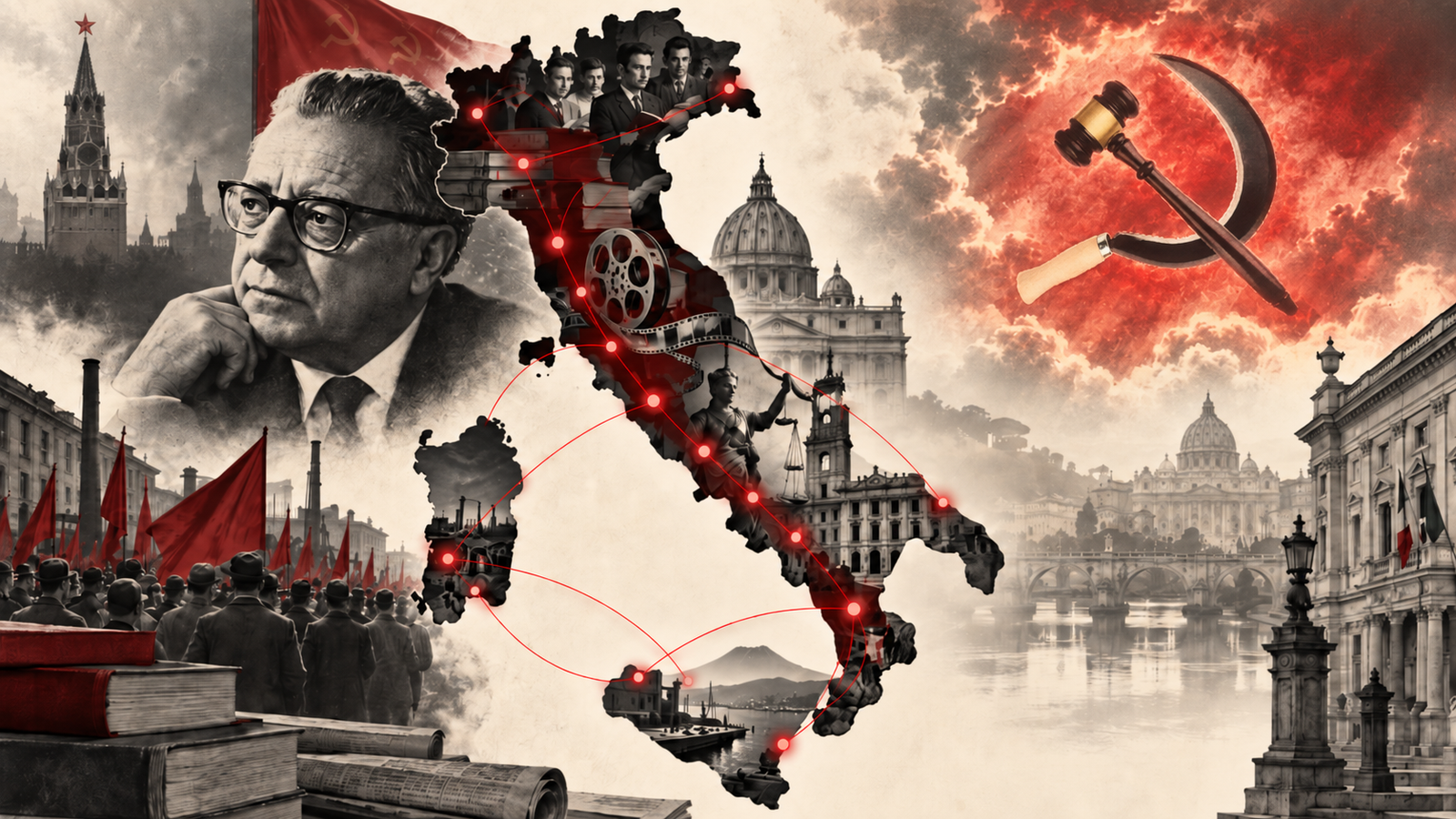
 From the Comintern to the “new party”: penetration, cadre formation, cultural hegemony, and the persistence of the Soviet connection (Testo Italiano)
“Togliattization” does not mean the “Sovietization” of Italy on the Eastern European model, nor does it imply that every militant, trade unionist, intellectual, or official of the Italian Communist Party (PCI) was an agent of Moscow.
It is the transformation of Italian communism, born within the Comintern system, from a minority revolutionary party into a large popular party, a social, institutional, and cultural network of and within the Republic. The strategic genealogy predates Togliatti; it derives from Stalin, from Moscow-style discipline and cadre training; from Zhdanov, who in the postwar period codified the opposition between the “two camps”; and from the network of party schools, with Frattocchie at the top in Italy. Togliatti was decisive because he translated Soviet strategy into a national, legal, and durable form.[1]
Thesis. Togliattization is therefore the Italianization of Soviet politico-military strategy: not the Red Army in Rome, but a national party capable of entering the Constitution, the municipalities, and the institutions, and of organizing, in functional order, its own transmission belts: Party, Trade Union, Judiciary, Entertainment, Culture, Cooperatives, Associations. The hierarchy is strict: the center decides, the organization mobilizes, the institutional sphere then makes orientations durable, the instruments that shape imagination and language come next, and finally the economic and associational structures make the presence capillary.
“Togliattization” is not a totalizing category: it can be distinguished on four levels. First: documentary facts—the original membership in the Comintern, Togliatti’s role in the International, adherence to the Cominform, cadre training, the naming of Frattocchie after Andrei Zhdanov, the mass structure, Soviet funding.
Second: a strong historical inference—the legalistic and national road made the PCI far more deeply entrenched than a small insurrectionary party would have been.
Third: hypotheses to be tested case by case—which cultural or informational campaigns responded directly to directives from Moscow; which subjects were conscious agents of influence; which institutional decisions were conditioned by Soviet apparatuses. Fourth: we must avoid automatically considering “Soviet” every dialoguing Catholic, every left-wing intellectual, every CGIL trade unionist, or every critic of the United States. That would be a mirror-image error to the habit of attributing to the CIA any fact incompatible with the communist narrative.
This method does not weaken the thesis. It makes it harder to dismantle, because it separates the system that is actually documented from individual responsibilities, which require specific proof.
1. Before Togliatti: Stalin, the Comintern, and party discipline
The starting point is not 1944. The Communist Party of Italy was born in January 1921 as the national section of the Communist International. Paolo Spriano, working on the archives of the state, the PCI, and the Comintern, describes the communist movement as highly centralized and having in Moscow its own “center of direction and propulsion.” Directives, controversies, discipline, and the selection of leaders took shape within a supranational system before the Italian “new party” existed.[2]
Togliatti emerged from this universe. After the Congress of Lyon in 1926, he became the representative of the PCd’I to the Executive of the Comintern; in the 1930s he entered its secretariat and, together with Georgi Dimitrov, became a prominent figure in the organization. In 1937 he was sent to Spain as a Comintern leader and political adviser. His decisive experience was not that of an Italian communist occasionally connected to Moscow, but that of a professional of the international communist movement, trained in a general strategy across different national situations.
Stalin and the Comintern set the line and the discipline; Andrei Zhdanov codified them in the orthodoxy of the two camps; the school system reproduced cadres and language; Frattocchie was the Italian summit; Togliatti, shaped within the International, adapted that legacy to republican democracy. Togliatti was therefore a political consequence of the system, even while remaining the original author of the Italian translation.
- 1944: Togliatti translates the system into Italian democracy
Upon his return to Italy in March 1944, Togliatti did not propose insurrection. He accepted the monarchy, entered the anti-fascist governments of national unity, and imposed on the PCI the “new party”: a mass party, rooted in society, capable of gathering workers, peasants, the middle classes, intellectuals, small business owners, and magistrates, operating within and through democracy.
Socialist transformation was recast as the gradual conquest of positions in the “public sphere,” through the expansion of the Party, the widening of democracy, and “structural reforms.”[3]
This was the decisive mutation. Italian communism abandoned the Russian form of October, not the final transformation. The immediate seizure of the Palace was replaced by a gradual expansion within society, and then within language, organizations, administrations, and the levers of national legitimacy.
Togliatti said so unambiguously: the terrain of democracy had been conquered “in order to move, upon it, toward socialism”; the forms of democratic and constitutional life could therefore be regarded not as an obstacle, but as an aid to socialist construction. In this conception, legality is not a simple renunciation: it is an operational field.[4]
The choice was effective. The PCI went from half a million members in 1944 to more than two million at the beginning of the 1950s, with a capillary network of local sections and factory cells, a strong presence in the CGIL, a national daily newspaper, and broad representation in local government. A “mass integration party”: not merely an electoral actor, but a political community that organized parts of social life.[5]
3. Not Sovietizing the state: nationalizing communism
The difference between Sovietization and Togliattization is the core of the thesis. In Poland, Hungary, Czechoslovakia, or Bulgaria, communist transformation occurred, in different ways, through Soviet occupation, the elimination of pluralism, and the construction of states modeled on the USSR. In Italy this path was not realistic: it was occupied and then allied with the West, with a strong Catholic Church, a multiparty system, and, from 1949 onward, was a founding member of NATO.
Togliatti therefore built a communism national in form, accepted as a constituent force of the Republic and not as a foreign body. Nationalization increased its capacity for penetration: a slogan coming from a party perceived as Italian had far greater force than the same slogan uttered by Moscow. That was Muenzenberg’s rule.[6]
Togliattization can therefore be defined as the transformation of an internationalist force into a national system of permanent presence: the party does not “control everything,” but seeks to make itself indispensable at decisive nodes of society; it does not abolish institutions, it enters them, contests or steers their language, intervenes in conflicts, and helps define social priorities and public memory. Its strength lies in renouncing a formal monopoly of power.
4. Article 7: the tactical masterpiece of the relationship with Catholics
The communist vote on Article 7 of the Constitution swept away suspicions of “Jacobinism” surrounding Togliatti’s strategy. On March 25, 1947, the PCI voted in favor of including the Lateran Pacts in the Constitution, after having previously supported more restrictive positions. Togliatti justified the vote in terms of “religious peace” and the need to avoid a rupture between communist and Catholic workers.[7]
Togliatti understood the impossibility of frontal combat against the religion of the majority of Italians. The great cultural antagonist was not to be destroyed: it could be forced into compromise and separated from militant anti-communism. The PCI thus gained an institutional respectability that no revolutionary propaganda could ever have given it.
This does not mean that the Vatican and the PCI were strategic allies, nor that Article 7 was “Soviet.” Togliattization also advanced through agreements with non-communist forces, provided the agreement expanded the PCI’s political space.
Here we reach the point that the history of relations between the PCI and Catholics alone is not enough to explain. The constitutional legitimization of the PCI occurred without a parallel, public, national, and lasting reckoning with the communist violence committed during and after the civil war. By “silence” we do not mean the literal absence of every condemnation, but something politically more significant: the failure to name the phenomenon as a national issue linked to the historical responsibility of Italian communism.
Reducing it to the Emilian “triangle of death” alone—as Pius XII did—meant mutilating the geography of the facts: Porzûs on the eastern border, Schio in the Veneto, and the violence in the “Red Republic of Caulonia” in Calabria are by themselves enough to mark out a much broader perimeter.[8]
Pius XII, Alcide De Gasperi, and Giorgio Almirante maintained a code of silence. De Gasperi and Almirante acted within a defeated country, occupied and embedded in international balances that severely limited their freedom of action and expression. That may explain, without justifying, their silence. The same mitigating circumstance cannot be applied to the Vatican.
Pius XII had a voice, instruments, a capillary episcopal network, and the full ability to define communism and its massacres.
What happened on October 28, 1956 is illuminating. In his radio message to Emilia, Pius XII recalled that perhaps in no other region had there been such a “slaughter of priests,” yet he did not name the communist perpetrators; on that same day, speaking of Hungary—in the very same day—the encyclical Luctuosissimi eventus pointed to the “promoters of atheistic communism.”
The Pontiff knew of both realities and veiled one of them. Italian blood thus became a national political accusation weighing on the PCI.[9]
The effect was enormous and is still felt today. The PCI could be opposed electorally and, at the same time, enter the Republic as a constituent force without being forced to bear in public discourse the full weight of the crimes committed by partisans and openly communist armed groups.
The PCI derived from this—and exploited—a moral preeminence based not on the absence of guilt, but on the different visibility assigned to the guilt of others and to its own. The original omertà thus became a national grammar: “fascist” remained an immediate moral and political qualifier; “communist,” when applied to crimes, progressively became a word to be avoided.
In the 1960s this asymmetry received further consolidation on the ecclesiastical side. In August 1962, Cardinal Eugène Tisserant met in Metz with Metropolitan Nikodim, who was responsible for the external relations of the Moscow Patriarchate.
The precise nature of the so-called “Metz agreement” remains debated; what is documented, however, are the meeting, the reassurances about the non-political character of the Council, and the subsequent arrival of the Moscow observers. It is equally documented that the Patriarchate operated under the close supervision of the Soviet state.
The political fact is therefore hard to evade: the Italian state dealt with a Vatican whose autonomy from Moscow was crippled. The Second Vatican Council did not formulate a condemnation of communism, even though numerous Council Fathers asked for one.[10]
On August 3, 2025, on In Onda, the La7 program, Paolo Mieli showed that the different view of communist and fascist terrorism is still operative. Mieli stressed the absence of the adjective “communist” in commemorations of the victims of red terrorism, whereas black terrorists are always “fascists.” A double lexical standard still exists. Seventy years after the war, the word hides the fact; it tries to hide it: contra facta non valet argumentum.[11]
5. Zhdanov, the Cominform, and Frattocchie: doctrine and cadres
The Cominform was born in September 1947, a few months after the exclusion of the communists from government. In the report presented at the founding conference, Andrei Zhdanov defined the world as divided into two opposing camps: on the one hand the “imperialist and anti-democratic” camp led by the United States, and on the other the “anti-imperialist and democratic” camp led by the Soviet Union. The PCI joined the new organization. Domestically, the PCI nationalized itself and participated in the Constitution; internationally, it remained within the communist system.[12]
Stalin indicated Togliatti as a possible secretary of the Cominform; he resisted the appointment, asserting the need to remain in Italy. It is hard to imagine a clearer symbol of the strategy: the leader most useful to the international movement remained in the decisive national theater.[13]
The school at Frattocchie reflects the PCI’s organizational effectiveness. The party’s central school was founded in 1944; in 1950 it was named the “Andrei Zhdanov Central Cadre School.”
Soon afterward the name was changed to the “Togliatti Institute” and in 1955 to the “Institute of Communist Studies.” The political meaning is clear: in 1950, in the midst of the Cold War and with the PCI in opposition, the main Italian center for cadre formation bore the name of the man of the doctrine of the two camps and of the Cominform. It was not a peripheral cultural club: it was the summit of the pyramidal training system.[14]
The central schools trained officials of the central organs and federal leaders; at the local level, courses were organized for those who would work in the sections, while in the cells training reached the rank and file of militants. At the top of the system were the courses of the CPSU higher school in Moscow. The selection of students involved the cadre and school commissions, the provincial federation, and the direction of the Institute, with verification of “political conduct” and social background. Frattocchie was not an isolated college, but the Italian upper level of training designed to guarantee functionaries, language, and political identity.[15]
Togliattization, seen from Frattocchie, is not a metaphor. It is the reproduction of political personnel: language, discipline, interpretation of history, organizational techniques, selection of cadres. A mass party lasts for decades only if it has functionaries capable of reproducing its culture.
A later confirmation comes from Rossana Rossanda. On March 28, 1978, twelve days after Via Fani, Rossanda wrote in Il Manifesto that the Red Brigades called to mind a “family album” and explicitly invoked the courses on Stalin and Zhdanov. The significance of the testimony is precise: a communist leader recognized in the BR the Stalinist-Zhdanovist pedagogy.
The reaction was immediate; on April 2 Rossanda noted that “the PCI has felt offended.” The reference therefore measures the persistence, thirty years later, of a still recognizable politico-linguistic matrix.[16]
The “cadre factory” also reached the justice system. The formula “magistrates trained at Frattocchie” points to the apex of a pyramidal structure that trained officials and leaders, organized the “training of trainers” for the periphery, and remained active until 1993. Institutional penetration did not require every magistrate to sit physically in those classrooms: it required a common culture, cadre selection, local schools, and organizational continuity. In this sense, significant sectors of left-wing judicial culture can be read as products of the political-educational ecosystem radiated by the party.[17]
Massimo Caprara testified on June 6, 2005, in the Court of Trento. Togliatti’s former private secretary described a system of non-public affiliation of magistrates to the PCI: local sections reported the names to Edoardo D’Onofrio, head of the Cadres Office, and the lists—which he called “sealed fiches”—were kept secret by the Party.
Caprara specified that he had not personally seen the register and indicated some magistrates as probable affiliates without producing direct documentary proof. The new point is the archival corroboration of the channel: studies by the Gramsci Foundation document that materials from the Cadres Office were in fact transferred to the USSR; this confirms the practice of transmission to Moscow.[18]
Magistratura Democratica was then founded in 1964. Its own historical reconstruction acknowledges the challenge to the neutrality of interpretation and to the merely technical role of the judge; at its Rome congress in 1971, Vincenzo Accattatis, Luigi Ferrajoli, and Salvatore Senese presented “For a Political Strategy of Magistratura Democratica,” a subversive text that placed the exercise of jurisdiction within social and class conflict.
This is presented as evidence of a political management of justice calibrated to Marxist and class-based categories, organized within the judiciary and surviving the end of the PCI. It is in this continuity—more than in the impossible task of counting party cards—that penetration down to the present day is measured.[19]
6. Münzenberg: distance from the source as a force multiplier
Willi Münzenberg provides the key to understanding another level. In Comintern practice, front organizations and campaigns aimed at non-communists served to carry messages and objectives beyond the perimeter of the party. Münzenberg built networks capable of involving non-communist political and cultural personalities, humanitarian associations, newspapers, and public initiatives: credibility increased the farther away the communist source appeared.[20]
To apply the “Münzenberg method” mechanically to republican Italy would be simplistic. Not every progressive association was a cover; not every intellectual close to the PCI was remotely controlled. But a political message becomes more powerful when it appears neutral, even though in fact it is useful to the Party, which can thus influence a multitude through autonomous subjects, whether or not they are aware of sharing an important part of the Party’s agenda.
This is the zone in which Togliattization and the Münzenberg method overlap: the former builds national rootedness; the latter explains how a political center can multiply its weight through associational, cultural, and media peripheries, some conscious, others simply convergent.
The place in which the method became most powerful, however, was culture. In Italy the PCI did not consider publishing, cinema, theater, the arts, and entertainment as an elegant frame around politics: it treated them as infrastructures. From the outset Rinascita was an organ for elaborating and disseminating the party’s cultural policy; communist publishing built its own publishing houses and distribution networks, up to and including Editori Riuniti; film clubs entered the party’s pedagogy of the masses. Recent studies of the PCI’s film policy explicitly speak of a coherent plan for rooting itself in the country’s cultural and economic infrastructures.[21]
This does not mean that every writer, actor, director, or professor received orders from Botteghe Oscure. The mechanism would have been far less effective. The Party built a system of prestige, access, journals, publishers, associations, circles, prizes, festivals, and mediations within which a very large part of the cultural world found—and still finds—advantage, identity, or political affinity.
The artist can remain formally autonomous and, precisely for that reason, become a more credible vector. This is the Münzenberg logic in its mature form: the message persuades more effectively when the party source disappears behind the intermediary’s prestige.[22]
This network was the backbone of the moral preeminence described above. Politics decided the line; culture turned it into common sense; entertainment gave it faces, emotions, and memory. Thus the PCI could lose elections and win battles of legitimacy: what came from its universe was often perceived as national culture, while anti-communism automatically became “fascism.” The Münzenberg method and Togliattization meet here: not in visible command, but in the ability to make appear spontaneous what a long organizational effort had made normal.
7. The “transmission belts”
The belts are ordered according to functional priorities. First the Party, which sets the line; then what organizes the masses; then those who transform a political orientation into institutional culture; next come the instruments that conquer imagination and language; finally the economic and associational structures that make the presence everyday and capillary. The chain is therefore:
Party → Trade Union → Judiciary → Entertainment → Culture → Cooperatives → Associations.[23]
The Party is the first belt because it is the center of command and formation. Togliatti takes up the notion of the party as a “collective intellectual”: not merely an electoral machine, but an organization that embodies a philosophy, selects cadres, and gives coherence to diverse experiences.
The Trade Union comes immediately afterward: it transfers the line to the workplace, organizes concrete interests, and turns doctrine into mass belonging. After the split in trade-union unity in 1948, the CGIL became the main communist and socialist trade union and offered the PCI a permanent channel to millions of workers.[24]
The Judiciary occupies third place because it introduces an institutional leap in quality. Togliatti regarded the judiciary as one of the arenas to be reformed and even proposed electing part of it and introducing permanent forms of popular oversight; later, an openly political judicial culture also organized itself within Magistratura Democratica. Caprara’s testimony adds the issue of non-public party affiliations.
Entertainment precedes Culture because it acts before conscious adherence. Cinema, theater, music, and later television give faces, emotions, and memory to a reading of the world. Culture—universities, publishing, journals, criticism, historiography, intellectuals—performs the next step: it turns images and slogans into legitimate categories of public discourse. Togliatti himself rejected the separation between politics and culture, and between art and real life. It is here that the Münzenberg method reaches its maximum effectiveness: the message persuades all the more the less it appears to come from the party.
Cooperatives come next because they give the network a material base. Work, credit, services, contracts, consumption, and local administration transform political solidarity into interests, skills, and careers. Associations close the chain: people’s houses, women’s and youth organizations, recreational, sports, and film clubs multiply points of contact and, above all, increase the apparent distance from the party source. The greatest success occurs when a category born in communist vocabulary can be reproduced autonomously by a non-communist newspaper, a lecturer, a director, a priest, a magistrate, or a civic movement.
The strategic result does not require total control of the state. It requires that a significant part of social life pass through an ecosystem capable of offering language, representation, solidarity, training, prestige, and opportunities. That is why the belts are ordered as they are: from command to mobilization, from institutionalization to persuasion, from the economic base to associational capillarity. Once the circuit is mature, it can continue to function even if the party that built it changes its name or disappears.
8. Gold from Moscow: not just sentimental ties
The PCI-USSR relationship was not merely one of ideological affinity. A report by the Parliamentary Commission on Terrorism and Massacres reconstructed, on the basis of Soviet documents and other sources, financial and logistical flows between the CPSU and the PCI in the 1960s and 1970s; the order dismissing the investigation into the so-called “Red Gladio,” while finding that corruption of Italian citizens in the Soviet interest could not be proved to the required legal standard, referred to a “considerable flow of money” from the CPSU, training courses, and commercial facilitation.[25]
The parliamentary chronology records, for example, $6.5 million to the PCI in 1976 according to documentation discussed in the Senate; in 1977 several transfers of one million dollars each are recorded; and for 1978 and 1979, annual appropriations of four million dollars from the CPSU’s international fund.[26]
This does not authorize the crude formula “the PCI carried out every order from Moscow.” It does, however, show that the relationship with the USSR remained concrete, material, and confidential even when the party claimed growing national autonomy. The strategy of Togliattization held the two aspects together: Italian tactical autonomy and the persistence of the international bond.
Togliatti made a decisive contribution to the republican Constitution and considered the Charter the PCI’s “fundamental program.” This fact is often used as proof of the full liberal-democratic conversion of Italian communism; that is an incomplete reading. For Togliatti, the Constitution was also the space within which to realize, legally, a “progressive democracy” open to structural reforms, public and cooperative ownership, economic planning, and the political advancement of the popular classes.[27]
Togliattization therefore does not consist in denying the democratic character of the Charter. It consists in understanding that part of communist strategy chose to identify its own advance with an expansive implementation of the Constitution. Political conquest could thus present itself not as subversion of the republican order, but as its more coherent realization.
9. 1956-1991: crisis of Stalinism, not the end of the system
The Soviet repression of Hungary in 1956 and the Twentieth Congress of the CPSU forced the PCI into a change of course, not into the dissolution of the system. The “Italian road to socialism” acquired greater theoretical autonomy and the party accentuated democratic gradualism. But the crisis of the Soviet model did not retroactively erase the infrastructure built in the previous decade: mass organization, schools, administrations, trade unionism, associations, and culture continued to live on.[28]
Indeed, one of the characteristics of Togliattization is precisely the ability to survive the loss of Soviet prestige. Once an infrastructure has become national, it can distance itself from the source without dissolving. That is the difference between a political colony and a rooted political culture.
After Togliatti’s death in 1964, the PCI progressively deepened its autonomy, up to Eurocommunism and Berlinguer’s positions on NATO. It would nevertheless be wrong to turn this evolution into an instant rupture. Parliamentary documents show that Soviet funding continued in the 1970s, while Moscow still exerted political pressure on the PCI.[29]
Togliattization must therefore be distinguished from “fidelity to Moscow” in the strict sense. The more durable process was internal: generations of administrators, trade unionists, journalists, functionaries, and intellectuals were formed within categories and networks born during the Togliatti era. Even as the USSR became more distant, the Italy shaped by that long rooting did not automatically return to the Italy of 1943.
10. 1991-1999: the party disappears, the network does not
The 1991 break was real, but it did not erase the previous history. The birth of the PDS in 1991 and of the Democrats of the Left in 1998 shows that the legal end of the PCI did not entail the immediate disappearance of its political personnel, its organizational skills, or the social networks built over half a century. Programs, alliances, and political culture changed, adapting to the times. The preexisting network survived intact and found its strongest foothold precisely in the courts.
Togliattization was tested and it passed the test: the national infrastructure survived the end of the USSR that had generated it and was able radically to modify its position within NATO.
1999 showed the scope of the transformation. In March 1999, the government led by Massimo D’Alema, who came from the PCI-PDS and was then with the Democrats of the Left, took part in NATO military operations against the communist-led Federal Republic of Yugoslavia. The Italian Armed Forces, in the author’s formulation, committed high treason because they carried out acts of war without parliamentary authorization.
Parliamentary records document the “responsible participation in NATO military operations” and the subsequent measures relating to the missions in the Balkans.
This fact does not prove continuity with Moscow: it proves the opposite, namely the capacity of a ruling class and of politico-organizational apparatuses to survive by changing their international point of reference. This is the concluding paradox: the national communist structure survives when the Soviet center no longer exists.[30]
11. Conclusion
The Togliattization of Italy is the process through which a “party of struggle and government” born in the COMINTERN, adapted by Togliatti to republican legality, spread through cadre formation and the “transmission belts” and survived the world that had generated it.
Its principal instrument was not hidden clandestinity but organized visibility: Party, Trade Union, Judiciary as a field of institutional culture, Entertainment, Culture, Cooperatives, and Associations, with the armed formations—those of the “family album”—as collateral actors kept at a safe distance.
Clandestine activity—funding, intelligence, reserved operations—constituted an additional level, important but not necessary to explain the entire phenomenon. Precisely because the system took root in public and legal forms, it was able to survive Budapest, de-Stalinization, Togliatti’s death, the end of the PCI, and the dissolution of the USSR, which in concrete terms brought “communist terrorism” to an end after Togliattization had already erased the term from common usage.
The most important historical result was a paradox. Italian communism became more effective the more Italian it appeared. Formal distance from Moscow did not erase strategic compatibility with Moscow; on the contrary, in some phases it made that compatibility more politically marketable.
The Münzenberg method teaches that distance from the source increases the credibility of the effect; Togliatti applied it in Italy in a more refined form: he transformed the party itself into the Italian source of a political culture that no longer needed to display a Soviet passport, even though the ties were and remained close until the flag was lowered over the Kremlin.
The deepest continuities are four and converge. The first is moral: the legitimization of the PCI without a symmetrical public naming of communist crimes produced a credit as concrete as it was unjustified, destined to infect national political life through both communist and fascist terrorism, while at the same time infecting the Vatican and limiting its autonomy.
The second is organizational: Frattocchie and the network of schools formed cadres and trainers for decades. The third is institutional and cultural: political and legal languages, publishing, cinema, entertainment, and intellectuals transformed partisan categories into national categories.
The first three were force multipliers from which the fourth, “adaptive” characteristic arose: after 1991, the PCI’s ruling class repositioned itself within the new neoconservative NATO system, an outcome that not even Aldo Moro would have imagined.
“Did Italy become communist?” Evidently not. The question is: “How much of the language, the social networks, the criteria of legitimacy, the careers, and the mediating structures built by the PCI entered the Republic permanently and survived the PCI itself and the USSR?” It is by this survival, more than by electoral percentages, that the depth of Togliattization is measured.
[1] The category “Togliattization” is defined here by the author as an interpretive tool. For basic data on the “new party,” the Italian road, and the connection with the USSR: Treccani, “Togliatti, Palmiro,” Enciclopedia on line, https://www.treccani.it/enciclopedia/palmiro-togliatti/ ; Treccani, “Partito comunista italiano,” https://www.treccani.it/enciclopedia/partito-comunista-italiano/ .
[2] Paolo Spriano, Storia del Partito comunista italiano, I. Da Bordiga a Gramsci, Einaudi, Turin 1967, Introduction: the PCI was born as the national section of a movement whose “center of direction and propulsion” was in Moscow; see also Treccani, “Partiti comunisti,” Dizionario di Storia, and “Togliatti, Palmiro,” Dizionario Biografico.
[3] Treccani, “Partito comunista italiano,” Dizionario di Storia: on the Salerno Turn, the “new party,” “progressive democracy,” and socialist transformation through the gradual advance of the masses and structural reforms. https://www.treccani.it/enciclopedia/partito-comunista-italiano_%28Dizionario-di-Storia%29/ .
[4] Palmiro Togliatti, La politica nel pensiero e nell’azione. Scritti e discorsi 1917-1964, edited by Michele Ciliberto and Giuseppe Vacca, Bompiani, Milan 2014, section on republican democracy: Togliatti states that “we conquered the terrain of democracy in order to move, upon it, toward socialism” and regards democratic and constitutional forms as an aid to socialist construction.
[5] Treccani, “La comunicazione del Pci da Livorno a Rimini”: approximately 500,000 members in 1944, 1.8 million in 1945, and more than 2 million in 1950; a mass-integration party with a network of associations, clubs, and organizations. https://www.treccani.it/magazine/lingua_italiana/speciali/PCI/Novelli.html .
[6] https://pierolaporta.it/willi-munzenberg/
[7] On March 25, 1947, the PCI vote was decisive for the approval of Article 7. Togliatti justified the choice by citing the need for religious peace and the need to avoid a rupture between Communist/Socialist workers and Catholics. Treccani, “Assemblea costituente” and “I Patti lateranensi e la delusione di Calamandrei per l’articolo 7.” https://www.treccani.it/enciclopedia/assemblea-costituente-dir-cost_%28Diritto-on-line%29/ ; https://www.treccani.it/magazine/atlante/cultura/I_Patti_Lateranensi_e_la_delusione_di_Calamandrei_per_l_articolo_7.html . For U.S. readers: Article 7 places the relationship between the Italian state and the Catholic Church within the constitutional framework by recognizing the Lateran Pacts, the 1929 agreements that settled relations between Italy and the Holy See and established Vatican City State.
[8] On the geography of violence beyond Emilia: Tommaso Piffer (ed.), Porzus. Violenza e resistenza sul confine orientale, il Mulino, Bologna 2012, University of Milan record: https://air.unimi.it/handle/2434/225274 ; Sarah Morgan, “The Schio killings: a case study of partisan violence in post-war Italy,” Modern Italy, May 18, 2016: https://www.cambridge.org/core/journals/modern-italy/article/schio-killings-a-case-study-of-partisan-violence-in-postwar-italy/FFBBFA606EACBEDD885C845390B7B49E ; for Caulonia, see Simone Misiani, La repubblica di Caulonia, Rubbettino, 1994, and the ANPI reconstruction in Patria Indipendente: https://www.anpi.it/patria-indipendente/media/uploads/patria/2014/73-89_speciale_70cap8.pdf . The episodes differ in nature and context; they are cited here to reject a geographical reduction of the phenomenon to the “triangle of death” alone.
[9] Pius XII, Radiomessaggio alle popolazioni dell’Emilia, October 28, 1956: “In perhaps no region, as in yours, has there been such a slaughter of priests,” https://www.vatican.va/content/pius-xii/it/speeches/1956/documents/hf_p-xii_spe_19561028_emilia.html ; on the same day, Pius XII, Luctuosissimi eventus, on Hungary, speaks of a “terrible massacre” and the “promoters of atheistic communism”: https://www.vatican.va/content/pius-xii/it/encyclicals/documents/hf_p-xii_enc_28101956_luctuosissimi-eventus.html . The comparison concerns the different public characterization of those responsible, not the absence of a doctrinal condemnation of communism by the Church.
[10] On the Metz meeting and the arrival of Russian observers: Andrea Tornielli, “Il comunismo assente dal Concilio,” Vatican Insider-La Stampa, September 21, 2011, https://www.lastampa.it/vatican-insider/it/2011/09/21/news/il-comunismo-assente-dal-concilio-1.36931663/ . For the stronger interpretation of the so-called agreement, see Roberto de Mattei, Il Concilio Vaticano II. Una storia mai scritta, Lindau, Turin 2010, pp. 174-177. On Soviet state supervision of the Russian Orthodox Church and the role of the Department for External Church Relations headed by Nikodim from 1961: “Between Dialogue and Denunciation: The World Council of Churches, Religious Freedom, and Human Rights during the Cold War,” Contemporary European History, Cambridge University Press, https://www.cambridge.org/core/journals/contemporary-european-history/article/between-dialogue-and-denunciation-the-world-council-of-churches-religious-freedom-and-human-rights-during-the-cold-war/21D129EDA6DF116383A98A3C2377F964 .
[11] La7, In Onda, “Dibattito in studio, Botteri e Mieli sullo stragismo rosso e nero,” August 3, 2025, https://www.la7.it/in-onda/video/dibattito-in-studio-botteri-e-mieli-sullo-stragismo-rosso-e-nero-03-08-2025-606017 ; for a transcript and the context of the passage on the different use of “fascist” and “communist,” Adnkronos, August 6, 2025, republished by Padovanews: https://www.padovanews.it/2025/08/06/fascisti-comunisti-e-doppiopesisti-perche-le-frasi-di-mieli-a-in-onda-hanno-incendiato-i-social-video/ .
[12] U.S. Department of State, Office of the Historian, Foreign Relations of the United States (FRUS), 1947, vol. IV, telegram from Moscow dated October 6, 1947, summarizing the “two camps” declaration and Zhdanov’s report to the founding conference of the Cominform. https://history.state.gov/historicaldocuments/frus1947v04/d412 .
[13] Treccani, “Togliatti, Palmiro,” Dizionario Biografico: in 1947 Stalin indicated Togliatti as a possible secretary of the Cominform; the PCI leadership favored the appointment, but Togliatti insisted on remaining in Italy. https://www.treccani.it/enciclopedia/palmiro-togliatti_%28Dizionario-Biografico%29/ .
[14] Fondazione Gramsci, Guida agli archivi, “Istituto di studi comunisti ‘Palmiro Togliatti’”: the central school was launched in December 1944; the name “Scuola centrale quadri Andreij Ždanov” is documented in 1950, followed by “Istituto Togliatti” and, from 1955, “Istituto di studi comunisti.” The archival record cites the minutes of the PCI Secretariat of October 24, 1944 (Fondo Mosca, mf. 271) and Edoardo D’Onofrio, La funzione dell’Istituto di studi comunisti nell’attività educativa del Pci, Rome 1955. https://archivi.fondazionegramsci.org/gramsci-web/detail/IT-GRAMSCI-GUI00001-0000006/istituto-studi-comunisti-palmiro-togliatti.html ; general portal: https://archivi.fondazionegramsci.org/gramsci-web/ . For U.S. readers: Frattocchie is a locality southeast of Rome; in Italian political usage the name became shorthand for the PCI’s central party school.
[15] Fondazione Gramsci, ibid.: central schools for officials of the central party organs and federation leaders; local courses for party sections and training in the cells; at the top, courses at the CPSU Higher Party School in Moscow; joint selection by the cadres-and-schools commission, the provincial federation, and the Institute leadership, with review of “political conduct” and social background. The archival record also refers to FG, APC, Partito, Fondo Mosca, Sezione quadri e scuole di partito, mf. 292, doc. 1, Progetto per la creazione di vari tipi di scuola di partito per la formazione di quadri dirigenti, 1944.
[16] Rossana Rossanda, “Il discorso sulla dc,” il manifesto, March 28, 1978; idem, “L’album di famiglia” (later republished as “Il veterocomunismo della lotta armata”), il manifesto, April 2, 1978. In the second article Rossanda explicitly writes: “The PCI felt offended.” See also Rossanda’s official biography and il manifesto’s republication of March 17, 2018. For U.S. readers: Via Fani is the Rome street where Aldo Moro was kidnapped by the Red Brigades on March 16, 1978; five members of his escort were killed.
[17] Fondazione Gramsci, PCI Archive, “Istituto di studi comunisti ‘Palmiro Togliatti’”: the central school stood at the top of a pyramidal training system; in 1965 it was also assigned the task of “training the trainers” for peripheral organizations; the Institute remained active until 1993. https://archivi.fondazionegramsci.org/gramsci-web/detail/IT-GRAMSCI-GUI00001-0000006/istituto-studi-comunisti-palmiro-togliatti.html ; Anna Tonelli, A scuola di politica. Il modello comunista di Frattocchie (1944-1993), Laterza, Rome-Bari 2017; SISSCO review: https://www.sissco.it/recensione-annale/a-scuola-di-politica-il-modello-comunista-di-frattocchie-1944-1993/ .
[18] Stefano Zurlo, “È nascosto a Mosca il registro segreto dei magistrati del Pci,” il Giornale, June 6, 2005, reporting on Massimo Caprara’s deposition in the Trento trial. For independent corroboration of the archival channel to Moscow: Cristiana Pipitone, “Les archives du Parti communiste italien,” Cahiers d’histoire. Revue d’histoire critique, nos. 112-113, 2010, pp. 166-176. The Gramsci Foundation also documents the role of the Cadres Offices and the subsequent transfer of responsibilities to the Control Commissions. The complete trial transcript and any nominative register still remain to be obtained: the transfer of materials to Moscow does not, by itself, prove the existence of the specific list of magistrates.
[19] Magistratura Democratica, “Storia del gruppo”: MD was founded in 1964 and challenged “the neutrality of interpretation” and the merely technical role of the judge, https://www.magistraturademocratica.it/storia/ . On the document presented at the Rome congress of December 3-5, 1971, Vincenzo Accattatis-Luigi Ferrajoli-Salvatore Senese, Per una strategia politica di Magistratura democratica, see Riccardo Ferrante, in Scuola Superiore della Magistratura, Quaderno no. 34, 2024, pp. 130 ff.: https://www.storiadeldiritto.org/uploads/2/5/3/4/25343223/storia_magistr_associazionismo_ssm_quaderno_34_web.pdf . The organizational continuity of MD does not, by itself, prove continuity of PCI membership; the point concerns the persistence of an organized political-legal culture. For U.S. readers: in Italy, magistratura refers to the career judiciary and includes both judges and public prosecutors; Magistratura Democratica is an association within that professional body.
[20] Bernard S. Morris, “Communist International Front Organizations: Their Nature and Function,” World Politics, 9/1 (1956), pp. 76-87, on the role of the Comintern and Willi Münzenberg in building front organizations; Sean McMeekin, The Red Millionaire, Yale University Press, 2003. https://www.jstor.org/stable/2008869 ; https://academic.oup.com/yale-scholarship-online/book/22358 .
[21] Fondazione Gramsci, “Rinascita”: the journal was “from the beginning” an instrument for developing and disseminating the PCI’s cultural policy, https://fondazionegramsci.org/in-evidenza/rinascita/ ; Elisa Rogante, “Un libro per ogni compagno. Le case editrici del Pci dal 1944 al 1953,” Studi Storici, 4/2017, pp. 1133-1166, on the creation of publishing houses, distribution networks, and propaganda, https://www.carocci.it/prodotto/elisa-rogante-un-libro-per-ogni-compagno-le-case-editrici-del-pci-dal-1944-al-1953 ; Alessandro Laloni, “Per una modernizzazione alternativa. Il ruolo del cinema nella politica culturale del Partito comunista italiano (1949-1965),” Italia contemporanea, no. 306, 2024, pp. 112-136, DOI 10.3280/IC2024-306006: https://www.francoangeli.it/rivista/getArticoloFree/76798/En ; Treccani, “Pci, palestra di pedagogia,” includes film clubs among the party’s networks: https://www.treccani.it/magazine/lingua_italiana/speciali/PCI/Taviani.html . For U.S. readers: “Botteghe Oscure,” referenced in the text, was common shorthand for the PCI’s national headquarters on Via delle Botteghe Oscure in Rome.
[22] On the method of front organizations and the use of cultural personalities and environments as influence multipliers: Bernard S. Morris, “Communist International Front Organizations: Their Nature and Function,” World Politics, 9/1 (1956), pp. 76-87, https://www.jstor.org/stable/2008869 ; Sean McMeekin, The Red Millionaire. A Political Biography of Willi Münzenberg, Moscow’s Secret Propaganda Tsar in the West, Yale University Press, 2003. See also note 21.
[23] On the structure of the transmission belts: Treccani, “Pci, palestra di pedagogia,” on the network of party sections, women’s, sports, and youth organizations, trade unions, cooperatives, and film clubs; see also Palmiro Togliatti, La politica nel pensiero e nell’azione. Scritti e discorsi 1917-1964, edited by Michele Ciliberto and Giuseppe Vacca, Bompiani, Milan 2014, where the party is discussed as a “collective intellectual” and culture is conceived as inseparable from politics.
[24] Treccani, “Associazioni sindacali,” on the CGIL after the 1948 split; Treccani, “Partito comunista italiano,” on the PCI’s presence among union cadres and militants and in local government. On the historical function of trade unions and cooperatives as mass organizations, see Palmiro Togliatti, La politica nel pensiero e nell’azione, cited above, and Paolo Spriano, Storia del Partito comunista italiano. For U.S. readers: CGIL stands for Confederazione Generale Italiana del Lavoro (Italian General Confederation of Labour), one of Italy’s major national trade-union confederations; after 1948, Communist and Socialist currents were predominant within it.
[25] Parliamentary Commission of Inquiry on Terrorism in Italy and on the Causes of the Failure to Identify Those Responsible for the Massacres, 13th Legislature, report, chap. III, “Il controllo del Partito comunista italiano,” pp. 109 ff.; reference to the order of investigating judge Claudio D’Angelo dated July 6, 1994. https://documenti.camera.it/_dati/leg13/lavori/doc/xxiii/064v01t05p01_RS/INTERO_COM.pdf . For U.S. readers: “Red Gladio” was the label used in an Italian judicial investigation concerning alleged clandestine communist structures; the investigation cited in the text was closed without establishing the alleged corruption as a prosecutable fact.
[26] Senate of the Republic, 13th Legislature, sitting of December 2, 1999; documentation on Soviet funding of the PCI. The parliamentary chronology records transfers in 1977 and appropriations of $4 million for 1978 and again for 1979. https://www.senato.it/show-doc?id=5425&idoggetto=0&leg=13&tipodoc=resaula ; see also the Parliamentary Commission on Terrorism and Massacres, report cited above, pp. 113 ff.
[27] Treccani, “Togliatti, Palmiro,” Enciclopedia on line: “progressive democracy,” social rights, public and cooperative ownership, economic planning; Togliatti regarded the Constitution as the PCI’s “fundamental program.” https://www.treccani.it/enciclopedia/palmiro-togliatti/ .
[28] Treccani, “Partito comunista italiano”: the Twentieth Congress of the CPSU and the Soviet invasion of Hungary in 1956 forced a reconsideration of strategy and accentuated the democratic and gradualist features of the “Italian road to socialism.” https://www.treccani.it/enciclopedia/partito-comunista-italiano/ .
[29] Parliamentary Commission on Terrorism and Massacres, report cited above, chronology 1967-1979; Senate of the Republic, sitting of December 2, 1999. The parliamentary sources document the continuation of Soviet funding in the 1970s and political pressure from Moscow on the PCI. https://documenti.camera.it/_dati/leg13/lavori/doc/xxiii/064v01t05p01_RS/INTERO_COM.pdf .
[30] Treccani, “Partito democratico della sinistra”: the PDS was created in 1991 by decision of the PCI’s Twentieth Congress; from 1998, Democratici di sinistra (Democrats of the Left). Senate of the Republic, 13th Legislature, sitting of March 26, 1999: Prime Minister Massimo D’Alema reports on the “NATO military intervention in Serbia”; sitting of May 26, 1999: the Government claims “responsible participation in NATO military operations.” NATO, Operation Allied Force, March-June 1999. For U.S. readers: PDS stands for Partito Democratico della Sinistra (Democratic Party of the Left); DS stands for Democratici di Sinistra (Democrats of the Left). Both were successor organizations to the PCI, though with substantially changed programs and international alignments.
