
 Il generale Piero Laporta, membro fondatore di AIVEG (Associazione Internazionale delle Vittime degli Errori Giudiziari) e autore di indagini documentali ( https://t.ly/K1Grg ) sull’omicidio di Aldo Moro, il 15 agosto 2026 ha depositato presso il Tribunale di Roma una denuncia querela e notizie di reato, indirizzate anche al giudice per le indagini preliminari Francesco Patrone.
Il generale Laporta ha proceduto così poiché il quotidiano La Stampa (29 luglio e 2 agosto 2026) riferisce che il GIP, accogliendo l’opposizione dei familiari dell’appuntato dei Carabinieri Domenico Ricci alla richiesta di archiviazione, ha disposto il proseguimento delle indagini sul delitto Moro, incluso l’accertamento delle ulteriori persone presenti su via Fani.
Il generale Laporta chiede che gli elementi oggettivi e documentali delle proprie ricerche siano sottoposti a verifica scientifica. Di seguito alcuni dei più significativi tra i numerosi elementi forniti al giudice Patrone.
Fratture della IV, V, VI e VIII costola sinistra di Aldo Moro. Il generale Laporta chiede di accertare perché queste lesioni — dal 1978 a oggi — siano state taciute in otto corti d’assise e quattro commissioni parlamentari d’inchiesta. Chiede inoltre di chiarire le ragioni dell’inerzia delle parti civili su questo punto.
I cosiddetti “colpi a raggiera attorno al cuore”. Il generale Laporta sostiene che questa ricostruzione sia interamente e deliberatamente falsa, quantunque (o proprio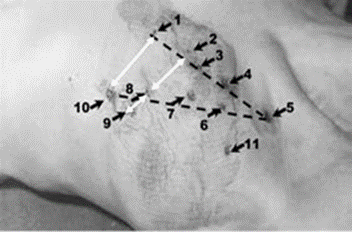
perché) asseverata dall’on. Giuseppe Fioroni, medico e presidente di una delle quattro commissioni parlamentari d’inchiesta. Dalla foto è evidente che non c’è alcun “colpo a Raggiera” intorno al cuore e l’area investita dai proiettili è poco al di sopra della milza, non “intorno al cuore” che si trova al centro del torace e dietro lo sterno, come il medico Fioroni ben sa. Laporta calunnia o Fioroni mente. Delle due l’una.
Nel dispaccio AGI delle 12:09 del 16 marzo 1978 si legge che il Procuratore Capo di Roma Giovanni De Matteo dichiarò ai giornalisti che nella Mini verde su via Fani si trovò un ordigno esplosivo di grande potenza. Lo stesso fatto è riferito dal rapporto della STASI dell’8 giugno 1978, MfS HA XXII 136, noto alla commissione dell’on. Fioroni. “L’esplosivo in via Fani” è scomparso da tutti i processi. Come mai? Il generale Laporta chiede che la magistratura indaghi.
Gli anagrammi. Il generale Laporta ha decifrato con metodo scientifico nove anagrammi. Nel quinto compare un ufficiale dei Carabinieri nella prigione di Moro. Il generale Laporta chiede che gli anagrammi siano sottoposti a verifica scientifica indipendente, per procedere poi a ulteriori indagini documentali anche per determinare l’identità di quell’ufficiale dei carabinieri.
La catena di comando della scorta. Il passaggio delle auto in via Fani, il 16 marzo 1978, fu previsto fin da un mese prima dai terroristi delle Brigate Rosse. Ciò significa che qualcuno ordinò al capo scorta, maresciallo dei carabinieri Oreste Leonardi, di transitare per via Fani, dove caddero nell’agguato preparato da un mese e morirono tutti. Il maresciallo dei carabinieri Oreste Leonardi prendeva ordini solo da un ufficiale dei carabinieri e non da altri. Il generale Laporta chiede che questo ufficiale sia identificato e i fatti siano indagati in ogni loro aspetto — per confutarli oppure confermarli e approfondirli.
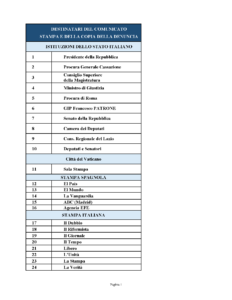
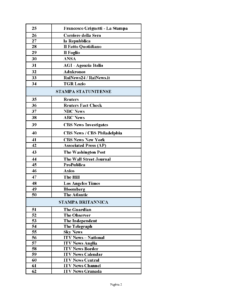
Il presente comunicato stampa e copia della denuncia depositata il 15 agosto 2026, tradotti in spagnolo, inglese, tedesco e russo, sono inviati agli indirizzi di posta elettronica degli enti elencati in allegato, nonché a numerosi altri destinatari. Tali documenti sono tutti pubblicati al link https://t.ly/7eBSL
PRESS RELEASE (English) MORO CASE: GENERAL PIERO LAPORTA
PRESS RELEASE (English)
MORO CASE: GENERAL PIERO LAPORTA
General Piero Laporta, a founding member of AIVEG (International Association of Victims of Judicial Errors) and the author of documentary investigations (https://t.ly/K1Grg) into the murder of Aldo Moro, filed with the Court of Rome on August 15, 2026 a criminal complaint/report of suspected offenses, also addressed to Judge for Preliminary Investigations Francesco Patrone.
General Laporta took this step because the daily newspaper La Stampa (July 29 and August 2, 2026) reported that the Judge for Preliminary Investigations, sustaining the objection filed by the family of Carabinieri officer Domenico Ricci against the prosecution’s request to dismiss the matter, ordered the Moro murder investigation to continue, including inquiries aimed at identifying any additional persons present on Via Fani.
General Laporta asks that the objective and documentary elements developed in his research be subjected to scientific verification. The following are some of the most significant among the numerous elements submitted to Judge Patrone.
Fractures of Aldo Moro’s left 4th, 5th, 6th, and 8th ribs.
General Laporta asks that the authorities determine why these injuries—from 1978 to the present—were not brought to light in eight Courts of Assize and four parliamentary commissions of inquiry. He also asks that the reasons for the inaction of the civil parties on this point be clarified.
The so-called “shots fanning out around the heart.”
General Laporta maintains that this reconstruction is entirely and deliberately false, even though—or precisely because—it was endorsed by Hon. Giuseppe Fioroni, a physician and the chairman of one of the four parliamentary commissions of inquiry. Either Laporta is making a false criminal accusation, or Fioroni is lying. It must be one or the other.
The explosive device on Via Fani.
An AGI wire dispatch issued at 12:09 p.m. on March 16, 1978 reported that Rome Chief Prosecutor Giovanni De Matteo told journalists that a high-powered explosive device had been found inside the green Mini on Via Fani. The same fact is reported in the STASI report of June 8, 1978, MfS HA XXII 136, which was known to the commission chaired by Hon. Fioroni. “The explosive device on Via Fani” disappeared from every trial. Why? General Laporta asks the judiciary to investigate.
The anagrams.
General Laporta has deciphered nine anagrams using what he describes as a scientific method. In the fifth, a Carabinieri officer appears in Moro’s place of captivity. General Laporta asks that the anagrams be subjected to independent scientific verification, followed, if warranted, by further documentary investigation aimed also at establishing the identity of that Carabinieri officer.
The security detail’s chain of command.
The passage of the cars through Via Fani on March 16, 1978 had been anticipated by the Red Brigades terrorists as much as one month in advance. This means that someone ordered the head of the security detail, Carabinieri Marshal Oreste Leonardi, to take Via Fani, where the convoy drove into an ambush that had been prepared for a month and all members of the detail were killed. Carabinieri Marshal Oreste Leonardi received orders only from a Carabinieri officer, not from anyone else. General Laporta asks that this officer be identified and that every aspect of these facts be investigated—to refute them or to confirm and pursue them further.
This press release and a copy of the complaint filed on August 15, 2026, translated into Spanish, English, German, and Russian, are being sent to the email addresses of the institutions listed in the attachment, as well as to numerous other recipients. These documents are published on Academia.edu at the link provided.
https://t.ly/7eBSL https://t.ly/wJo93
PUBLIC-VERSION COPY OF THE SUBMISSION ADDRESSED TO
THE COURT OF ROME AND TO THE JUDGE FOR PRELIMINARY INVESTIGATIONS FRANCESCO PATRONE
MEMORANDUM-PETITION AND CRIME REPORT PURSUANT TO ARTICLE 333 OF THE ITALIAN CODE OF CRIMINAL PROCEDURE
AND SUBMISSION OF EVIDENTIARY MATERIAL
requesting inclusion in the record, transmission to the public prosecutor, examination of the submitting party, and documented tracking of the filing and transmission
| Submitting Party | PIERO LAPORTA |
| Subject | Medical-forensic, ballistic, and documentary evidence to be re-examined; four rib fractures sustained by Aldo Moro; challenged compatibility of the false “radial shots” formulation with the evidence; circumstances of the killing; reconstruction of Via Fani; explosive device reported on Via Fani; chain of command of the security detail; possible third-party presence and external networks. |
| Attachments | Two volumes by the submitting party: https://t.ly/kgkiP, together with the documentation cited herein. |
The undersigned, Piero Laporta, a general officer of the Italian Army Corps of Engineers and the author of multi-year documentary investigations into the Moro murder (https://t.ly/kgkiP), sets forth the facts described herein insofar as they may constitute offenses prosecutable ex officio, and also submits them as a crime report pursuant to Art. 333 of the Italian Code of Criminal Procedure.
The submitting party states that he is acting in accordance with his institutional and moral duties, presenting to the Judicial Authority, as faithfully as possible, what is documented and distinguishing verifiable facts from his own interpretations and hypotheses.
1. Procedural Background and Reason for This Submission
According to La Stampa of July 29 and August 2, 2026, the Judge for Preliminary Investigations sustained the objection filed by the family of a member of the security detail against the Rome Public Prosecutor’s Office request to dismiss the case, thereby ordering the reopening and/or continuation of the investigation.
According to those reports, the order is said to have identified, among the matters requiring further investigation, the possible presence of third parties on Via Fani, the sheltering of a Red Brigades member by a former Italian Air Force officer, and the possible existence of external communications and support networks in the Via Gradoli area.
This distinction is not merely terminological: based on the press sources cited above, it does not appear that the Public Prosecutor’s Office spontaneously reopened the investigation; rather, the judge prevented dismissal and ordered further investigative steps. That decision makes the acquisition of the elements identified here both pertinent and urgent, because they directly concern the material facts of the massacre, the circumstances of Moro’s killing, and possible external responsibility.
The submitting party asks that the physical and documentary evidence be acquired, examined by qualified experts, and made available to the public prosecutor in charge; and that the prosecutor interview the submitting party as a person with knowledge of the facts, allowing him to identify sources, documents, individuals, and the technical basis for his deductions.
2. The Four Rib Fractures: Autopsy Evidence and a Decades-Long Omission
The forensic report describes, with respect to Aldo Moro’s left 4th, 5th, 6th, and 8th ribs, fracture findings showing reparative consolidation and callus formation, dating the occurrence of those fractures to between thirty and sixty days before the autopsy. That period falls within the time of the kidnapping. The existence of the four injuries is a documentary fact distinct from any hypothesis as to cause—torture, blows, or some other mechanism—which must be determined through examination of the original materials and a new multidisciplinary assessment.
According to the submitting party’s reconstruction, from May 9, 1978 to the present, this evidence was not transparently and fully placed before the eight Courts of Assize identified in his books, the four parliamentary commissions of inquiry, or the civil parties. That assertion should be verified by obtaining, for each proceeding and each Commission, the indexes to the case files, the versions of the autopsy report actually transmitted, the expert reports, and the transcripts or minutes in which the fractures may have been addressed.
It is not enough that the fractures were physically described in a report. It is necessary to determine who knew about them, what questions were put to the experts, whether the chronology of the injuries, the presence and maturation of the bone calluses, any interaction with the bullet tracks, and compatibility with the accounts given by those convicted were examined. If confirmed, the failure to conduct such inquiries would have affected the determination of the personal injuries inflicted during the kidnapping and the reconstruction of the murder.
3. The “Radial Shots” Formulation and the Role of the Second Moro Commission
The Parliamentary Commission of Inquiry into the Moro case, chaired by a physician, lent official credence to the depiction of the shots fired at Moro as arranged “radially,” that is, around the heart. The submitting party categorically challenges this false formulation as incompatible with the photographs of the body on the autopsy table, the location of the wounds, and the anatomical relationship among the heart, spleen, rib fractures, and ballistic wound tracks. The submitting party does not ask that his conclusion be accepted here as an already established fact; rather, he frames it as a technical question capable of objective verification.
| Figure 1 NO SHOTS IN A RADIAL PATTERN AROUND THE HEART |
The submitting party observes that, if the shots were truly arranged “around the heart,” the resulting depiction would place the heart in an anatomically incongruous relationship to the spleen. Precisely because this challenge can be assessed at a glance (ictu oculi) (Fig. 1) and by measurement, it is surprising that the issue does not appear to have been conclusively addressed by the Fioroni Commission and its consultants.
Accordingly, the submitting party requests a three-dimensional anatomical reconstruction based on photographs, radiographs, the complete autopsy record, physical evidence, and the coordinates of the wound tracks, separately identifying the position of the organs, entry and exit points, directions, distances, injuries to vital structures, and any interaction with the four fractured ribs.
The submitting party further notes that neither the physician who chaired the Commission, nor a Carabinieri colonel, nor a journalist—although, according to the documentation cited in the books, they were aware of the fractures—devoted an analysis to them commensurate with their significance. It should also be determined whether and to what extent this evidence was considered by the magistrates serving as consultants to the Commission and, at the present stage, in the filings of the interested parties.
These circumstances are not presented here as proof of individual responsibility already established. Rather, the request is to verify their objective basis, timing, and consequences and, only if the necessary predicates emerge, to assess any individual responsibility. To that end, it appears necessary to obtain minutes, expert reports, correspondence, and preparatory documents in order to determine who knew of the fractures, from what date, and what actions each person took or failed to take.
4. Three Firing Sequences, Clothing, and the Distribution of Bloodstains
Referring also to the assessments of an expert retained by a journalist, the submitting party maintains that Aldo Moro was struck in three distinct firing sequences and that this sequence is not satisfactorily explained by the version in which he was killed inside the Renault 4 while already fully dressed. He proposes a different reconstruction: Moro may have been kept alive, with his heart still beating, until he was dressed, so as to limit or otherwise alter the distribution of blood traces on the clothing. This is a serious hypothesis. It should not be presumed true, but it should be tested experimentally.
In particular, the submitting party observes that the injury to the left thumb—which, according to the experts, was the first in the sequence of fatal shots—if inflicted while Moro was wearing a shirt, vest, jacket, and trousers, should have produced more appreciable bleeding and blood transfer onto the shirt cuff and the other garments, as well as inside the Renault 4.
The bloodstains visible on the clothing and in the vehicle appear, instead, to be limited in relation to the overall extent of the bodily wounds. The following should therefore be re-examined separately: whether the injuries were inflicted while Moro was alive and their sequence; survival times; quantity and direction of bleeding; correspondence between bodily wounds and holes in the fabric; stains, flows, and absorption on each garment; any signs that Moro was dressed after being wounded; and the blood and ballistic residues in the Renault 4. It should also be determined whether—and why—the probing of the ballistic wound tracks was not ordered and documented while the body was still clothed.
The inquiry requires an integrated panel comprising forensic pathology, terminal ballistics, forensic hematology, bloodstain pattern analysis (BPA), textile science, and three-dimensional reconstruction.
The question presented must prevent a descriptive phrase—“radial shots,” whose anatomical and ballistic validity is specifically challenged by the submitting party on the basis of the cited evidence—from taking the place of measurement and scientific comparison of the physical evidence.
5. Via Fani, Third-Party Presence, and the Adequacy of the Investigative Leads
The new investigations concerning a Red Brigades member and a former Italian Air Force officer confirm that, almost fifty years later, the Judicial Authority still considers it possible to investigate external networks, covert activities, and relationships with state institutions or agencies.
The submitting party nevertheless believes that, although these inquiries are necessary, they are not by themselves sufficient to explain the military, political, and logistical planning, preparation, and execution of the operation. This assessment does not justify abandoning that line of inquiry, but it does require that it not become the exclusive perimeter of the investigation.
In the two attached books, the submitting party advances the hypothesis that Soviet special forces participated in the operation with the assistance of Italians who were unfaithful to their institutional duties!
This is the author’s conclusion, not a fact established by a court.
The submitting party therefore asks that this hypothesis be independently tested by obtaining and comparing: documentation from Italian and allied intelligence services; movements, cover arrangements, and presence of personnel linked to Soviet intelligence services; logistical networks and communications; military and diplomatic archives; compatibility among the training, weapons, timing, and methods of the operation; and any relationships with Italian institutions or structures. The anagram solutions proposed by the author likewise require an independent scientific assessment, under the standards specified in the following section.
5.1. The Fifth Anagram: “spia punita Arma”
The attached volume presents ten anagram solutions.
Nine of them were obtained by applying a method that the submitting party regards as rigorous, based on first establishing a single, unambiguous criterion both for identifying the passages to be decoded and for determining the point at which the anagramming process begins.
The tenth solution, by contrast, was obtained randomly. The submitting party believes it may be correct, but he does not present it—and does not believe he can present it—with the same degree of methodological reliability as the other nine. Among the nine solutions obtained under the predetermined criterion, the submitting party calls particular attention to the fifth anagram, in which the proposed decoding yields the sequence “spia punita Arma” [roughly, “spy punished by the Carabinieri”].
The sequence is not offered here as proof, nor as an already established identification of any individual. It may, however, have investigative significance if an independent scientific examination demonstrates that the solution is not the product of arbitrary selection or chance, is reproducible, and has meaningful statistical significance when compared with alternative solutions generated under the same criteria.
The inquiry should therefore proceed in two logically sequential stages, the second contingent on the first.
First, the nine solutions obtained under the single criterion described above—and the fifth anagram in particular—should be independently examined by a qualified university institution with expertise in computational linguistics, cryptanalysis, combinatorics, and statistics. The examination should reconstruct and formalize the criteria used to select the texts, the starting point of the decoding process, the algorithm or procedure used, the linguistic corpus, controls against post hoc selection, and the conditions required for replication.
The tenth solution, because it was obtained randomly, should be examined separately as an exploratory hypothesis, without assigning it in advance the same methodological weight, and with a view to determining whether it can be reproduced or independently rediscovered through formalized criteria.
Only if the examination of the fifth anagram produces a positive or otherwise scientifically significant result should the second line of inquiry be opened: determining whether, among officers of the Carabinieri serving between March 16 and May 9, 1978—and, if necessary, in the immediately preceding and following months—one or more individuals were subjected to disciplinary sanctions, suspensions, transfers, or other punitive or anomalous internal measures potentially capable of being related to the phrase “spia punita Arma.”
That inquiry would require obtaining personnel service records, performance and evaluation reports, disciplinary files, duty or service orders, and any other relevant personal or confidential documentation. The submitting party cannot lawfully access such materials; they can be obtained and cross-checked only by the Judicial Authority, under the procedures and safeguards prescribed by law.
In the attached books, the submitting party argues that a computational examination of the anagrams would already have been technically feasible using the computing resources available in 1978.
In any event, the tools available in the decades since then have become incomparably more powerful.
The submitting party therefore asks that it be determined why no independent methodological examination of possible anagrammatic content in Aldo Moro’s letters has ever been carried out, despite the passage of time and the continuing development of computing resources.
5.2. The Explosive Device Reported on Via Fani
A further element requires specific investigation. In the AGI wire dispatch “Moro rapito (28)” [“Moro Kidnapped (28)”], issued at 12:09 p.m. on March 16, 1978 and republished by the news agency in 2018, it was reported that the Chief Prosecutor of Rome, after returning to Piazzale Clodio from his inspection of the scene, told journalists that a green Mini containing an explosive device had been found a short distance from the site of the massacre and that bomb-disposal technicians had immediately removed the device.
Because the circumstance was publicly reported in the very first hours of the investigation, in the presence of journalists and on the basis of a direct statement by a senior magistrate of the Rome Public Prosecutor’s Office, it constitutes an independently verifiable documentary historical fact—separate from the still-unresolved question whether the device actually existed, what its nature was, and whether the initial report was accurate.
This report is accompanied by a second, foreign and contemporaneous documentary item that makes verification even more necessary.
A report of the Ministry for State Security of the German Democratic Republic (Ministerium für Staatssicherheit, MfS/STASI), dated Berlin, June 8, 1978 and identified in the archives as MfS HA XXII 136, compares the Moro kidnapping with a well-known kidnapping that occurred in West Germany in 1977 and expressly states, among the elements used to prepare the Via Fani operation, that “as a diversionary maneuver for the police” the attackers had parked a car containing a bomb a short distance from the site of the kidnapping.
The document, published and studied by a historian and discussed in a parliamentary hearing in 2016, requires reconstruction of the provenance of that specific information. The STASI report is not offered here as independent proof that the device actually existed, but as contemporaneous documentary confirmation that information about a car bomb was circulating. It must be determined whether the MfS obtained that information from the press, police communications, other intelligence services, or one of its own sources.
If the existence of the device were confirmed, it would fundamentally affect the operational reconstruction of Via Fani.
A car bomb would require investigators to determine who designed and prepared it; what explosive was used; what triggering mechanism was intended; where the device was assembled, stored, and loaded into the vehicle; what specialized skills were necessary; whether a nearby logistical base was used; and who actually had control of the Mini.
Formal ownership of the vehicle, standing alone, would not establish the owner’s participation. It must nevertheless be determined whether the owner knowingly allowed the vehicle to be used, or whether it had been stolen, transferred, or otherwise made available for the operation. The submitting party believes that an investigative issue of this magnitude should have been specifically examined and documented.
Even assuming purely hypothetically that this was a false alarm, a misunderstanding, or a report later found to be unfounded, the later disappearance of such a serious episode from the case narrative should have followed a transparent and documented judicial and technical determination.
It is therefore necessary to reconstruct who reported the vehicle and the device to the Chief Prosecutor; which bomb-disposal technicians responded; which vehicle was inspected and who owned it; what was actually found and removed; whether there are reports documenting the scene inspection, disarming, removal, evidence collection, analysis, or destruction; what the chain of custody was for any item recovered; whether fingerprints were taken from the inside and outside of the vehicle; and, above all, by what act and on the basis of what evidence the episode was later excluded from the investigative reconstruction. If such records do not exist or cannot be located, that absence itself should be specifically investigated, identifying the persons and offices that had possession of the information and of any physical evidence.
The broad public dissemination of the submitting party’s theories is not a substitute for proof, but it does demonstrate that the elements identified were not inaccessible.
The books cite sources, physical evidence, omissions, and persons to be interviewed. It is therefore necessary to compare them analytically with the case file, distinguishing in a transparent matrix among: documentary fact, testimony, technical inference, hypothesis, and conclusion still to be proved.
6. Chain of Command of the Security Detail and Integrity of the Via Fani Crime Scene
The submitting party reports that the Carabinieri marshal responsible for the security detail is said to have received orders from a Carabinieri lieutenant colonel and cites, in support of this assertion, writings attributed to that same officer. The point should be formally acquired and verified through documentary evidence. Because, according to statements cited in the attached books, the Red Brigades members are said to have known approximately one month in advance that the cars would pass through Via Fani, it is necessary to reconstruct fully who had formal or de facto authority to issue instructions to the head of the security detail and who determined the route, schedule, composition, and procedures of the service on the morning of March 16, 1978.
The inquiry cannot stop at the ordinary chain of command. Investigators should obtain duty records, written and oral orders, vehicle and movement logs, address books, telephone and radio contacts, shifts, substitutions, instructions concerning Moro’s security, and every change to the route in the preceding weeks. Where possible, superiors, colleagues, and family members familiar with the operational habits of the head of the security detail should also be interviewed, in order to determine whether any other officer or agency had the authority or influence to give him orders.
With respect to the ballistic reconstruction, the submitting party cites a statement attributed to that same officer—who later became a general—which should be obtained from its original source and verified. According to the statement, some spent cartridge cases found on the right side of Aldo Moro’s FIAT 130 were kicked with a foot into a storm drain by a magistrate who had arrived at the scene. If confirmed, this circumstance would affect the integrity of the original distribution of the evidence and, therefore, the possibility of reconstructing firing positions retrospectively. For this reason as well, the investigation should test the scientific plausibility of the trajectories reported by the Scientific Police and the possible presence of shooters other than the Red Brigades team officially recognized as having taken part.
7. Earlier Reports That Produced No Result
The submitting party has previously reported these and other elements to the Public Prosecutor’s Offices of Rome and Perugia. An earlier complaint, filed in 2024, was transferred among offices and was later the subject of dismissal orders. The identifying details of those proceedings are omitted from this public version. The submitting party states that he was never interviewed in detail concerning the technical elements or personal sources he had said he could identify.
This filing does not ask the judge handling the present matter to reconsider decisions made in unrelated case files. It does, however, point out that the prior dismissals make it even more important to avoid confining the new investigative activity to a marginal segment without addressing the fractures, autopsy, clothing, blood evidence, anagrams, explosive device reported on Via Fani, chain of command of the security detail, and possible third parties.
Precisely in light of those precedents, the submitting party has a specific interest in ensuring that the path of this filing remains fully documented and traceable. Characterizing it also as a crime report under Art. 333 c.p.p. does not purport to confer on the submitting party any procedural status that only the Judicial Authority may recognize. Rather, it is intended to make unequivocal the request that the specific facts presented here be evaluated to determine whether they constitute information indicating possible criminal offenses and, if the legal requirements are met, that the relevant reports be entered in the registers required by law and handled in accordance with the applicable procedures. The submitting party further states that he wishes to be informed of any request for dismissal under Art. 408(2) c.p.p., if he is recognized as an injured party and the statutory conditions are met. He also asks that, to the extent permitted by law, communications regarding the acquisition and any transmission of this filing be directed to him in the presence of retained counsel appointed at the time of filing pursuant to Art. 333, No. 2, c.p.p.
8. Requests
For the reasons stated above, the submitting party asks that this filing—also characterized, where applicable, as a crime report under Art. 333 c.p.p.—and its attachments be formally included in the proceeding or transmitted to the competent public prosecutor and, within the limits of the judge’s authority and the procedural posture of the case, that the following measures be taken or requested:
- Acquisition, registration, and transmission. Formally receive and register this memorandum-petition and crime report; include it in the proceeding identified in the caption or, if that is not procedurally possible, transmit a copy to the competent public prosecutor so that the prosecutor may assess the information concerning possible criminal offenses and coordinate it with the investigative steps already ordered, with the filing date and receiving office formally entered in the record;
- Examination of the submitting party. Order—or identify to the public prosecutor as a specific investigative topic—the examination of the submitting party as a person with knowledge of the facts, with a detailed record of the interview and the opportunity to submit sources and documents;
- Autopsy and fractures. Obtain the complete original autopsy documentation, radiographs, photographs, notes, samples, and records of the Institute of Forensic Medicine; identify everyone who was present; and order a new multidisciplinary assessment of the four fractures, their dating, and any interaction with the bullet tracks;
- Clothing and traces. Seize or obtain the garments and any physical evidence still in existence, reconstructing the chain of custody; perform blood, textile, and ballistic examinations; and examine the injury to the left thumb, the sequence of shots, and the hypothesis that Moro was dressed after being wounded;
- “Radial shots.” Determine through three-dimensional anatomical-ballistic modeling whether the formulation “shots arranged radially around the heart” is supported by the evidence; and identify the origin, authors, and institutional steps through which that formulation came to be officially credited;
- Commissions and trials. Obtain the records of the four parliamentary commissions and the eight proceedings identified by the submitting party, determining which versions of the autopsy report were transmitted and whether the fractures were brought to the attention of judges, experts, and civil parties;
- Persons with knowledge and consultants. Where deemed relevant and without any presumption of responsibility, interview the chairman of the parliamentary commission, the Carabinieri officer, the journalist, and any consultants cited in this filing concerning their respective knowledge of the fractures, the sources they used, and the reasons for any failure to investigate the matter fully or for any limited inquiry;
- Chain of command. Reconstruct the hierarchical and functional relationships of the head of the security detail, including those with the Carabinieri officer identified in the books; obtain the writings and other sources cited by the submitting party on this point; and identify any other officer or agency formally authorized, or in practice able, to give orders concerning the security detail and the route;
- Via Fani scene and ballistic evidence. Obtain and verify the original source of the statement attributed to the officer who later became a general concerning the movement of spent cartridge cases into a storm drain; reconstruct, to the extent still possible, their original locations, evidence collection, and chain of custody; and re-examine the plausibility of the trajectories and the possible presence of additional firing positions;
- Explosive device reported on Via Fani. Obtain from AGI the original text, newsroom records, and any available documentation relating to the dispatch “Moro rapito (28)” issued at 12:09 p.m. on March 16, 1978; obtain the scene-inspection reports and intervention logs of the Police, Carabinieri, and bomb-disposal units concerning the vehicle in question; identify the bomb-disposal technicians and other officials present and, where possible, the journalists who directly received the Chief Prosecutor’s statements; identify the green Mini, its owner, the person who actually had possession or control of it, and the exact location of the vehicle; determine whether an explosive device was in fact present, and if so its composition, origin, intended purpose, and triggering system, where it was designed, assembled, stored, and loaded into the car, what expertise was required, and whether there was a logistical base—even a temporary one—used in preparing or deploying it; reconstruct where any such device was transferred, examined, or destroyed and its chain of custody; also obtain, through the appropriate channels of judicial and archival cooperation, the original MfS/STASI report dated June 8, 1978 and identified as MfS HA XXII 136, together with any attachments and preparatory documents, and determine the specific source of the information concerning the car containing a bomb, including whether it came from the press, police communications, other intelligence services, or the MfS’s own sources; finally, identify the act, report, or order, if any, by which the episode was characterized as a false alarm, deemed irrelevant, or otherwise excluded from the judicial reconstruction and, if no such document exists, determine the reasons for its absence;
- Third parties and external networks. Coordinate the inquiries concerning the individuals already identified in the proceeding with a search for any additional shooters, logistical and communications networks, links to Italian or foreign agencies, and classified documentation, using the procedures prescribed by law;
- Scientific verification of the anagrams. Subject all ten anagram solutions identified by the submitting party to examination, expressly distinguishing the nine obtained through the single criterion described above from the tenth obtained randomly; submit the first nine—particularly the fifth anagram containing the sequence “spia punita Arma”—to an independent and reproducible examination by a qualified university institution, after formalizing the criteria for selecting the texts and the starting point of the decoding, the linguistic corpus, the generating algorithm or procedure, controls against post hoc selection, the probability of random occurrence, and a replication protocol; examine the tenth solution separately as an exploratory hypothesis, testing whether it can be reproduced through independent criteria;
- “Spia punita Arma” and Carabinieri records. Only if the expert examination is positive or otherwise statistically significant, obtain from the Carabinieri General Command, the Ministry of Defense, and the competent archives the personnel, performance, disciplinary, and service records necessary to determine whether, among officers serving during the period March 16-May 9, 1978 and during a reasonable interval immediately before and after that period, any individuals were subjected to sanctions, suspensions, transfers, or other punitive or anomalous internal measures compatible with the phrase; then determine, subject to the safeguards required by law, whether any relevant connection exists with the Moro kidnapping, the security detail, Via Fani, or intelligence and security structures;
- Preservation of evidence. Urgently adopt the measures necessary to prevent the loss, deterioration, or destruction of physical evidence, samples, paper records, and digital archives still in existence;
- Communications. Inform the submitting party and, after any appointment, retained counsel—within the limits permitted by law and consistent with investigative secrecy—of the identifying details of the proceeding into which the filing is placed, the public prosecutor’s office receiving it, and the identifying details of any transmission;
- Traceability of the filing and request for notice. Ensure that the record reflects the filing of this memorandum-petition and crime report and the procedural disposition assigned to it. The submitting party states that he wishes to be informed of any request for dismissal under Art. 408(2) c.p.p., if he qualifies as an injured party and the relevant requirements are met. In any event, to the extent permitted by law, he asks to receive communications concerning the acquisition and any transmission of this filing. Contact details are omitted from this public version.
9. Public Disclosure of the Filing
The submitting party reserved the right to make public the text he signed after it had been duly filed, as a measure of transparency and protection of his research. Publication is made within the limits permitted by Arts. 114 and 329 c.p.p. and by the rules governing the protection of personal data, with the omission of numbers, data, records, or content that may be covered by investigative secrecy or by a prohibition on publication. This version has been further anonymized by removing personal data and replacing names with descriptions of the individuals’ roles, without altering the substantive content of the requests and hypotheses set forth in the filed document.
August 15, 2026
Piero Laporta
