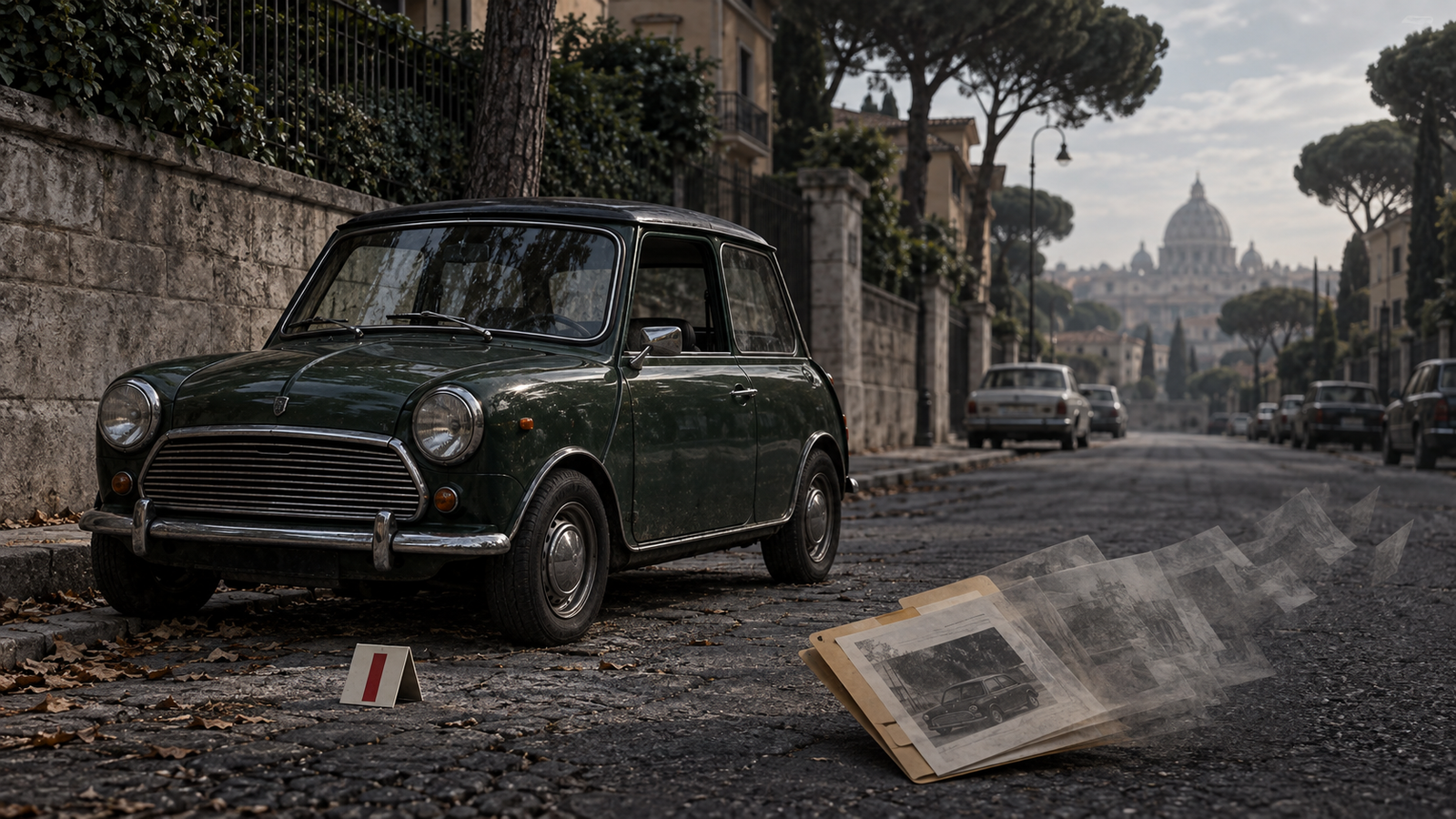
 At 12:09 p.m. on March 16, 1978, AGI reported a statement by Rome’s Chief Public Prosecutor: a high-yield explosive device had been found in the green Mini used by the commando unit. From that moment on, however, the device appears to have vanished—not from the crime scene, but from the official record.(Italian Version)
On March 16, 1978, only hours after the ambush in Via Fani, Rome’s Chief Public Prosecutor, Vanni De Matteo, personally went to the scene of the massacre and told reporters that a high-yield explosive device had been found in the green Mini used by the commando unit. The AGI news agency picked up and distributed his statement at 12:09 p.m. that same day.
The report did not remain confined to the newswire. Writing in the weekly L’Europeo after gathering the assessments of the bomb-disposal experts who had responded to the scene, Roberto Chiodi stated that, had the device been detonated, it could have caused as many as three hundred casualties. In short, it would have dwarfed the Bologna massacre of August 2, 1980.
No formal retraction of that statement appears anywhere in the judicial or parliamentary record of the case. Yet the report of the explosive device—made not by an anonymous source or a chance witness, but by the head of the Public Prosecutor’s Office—vanishes from the case files, leaving no trace of the process such information would ordinarily have followed: investigation, verification, and disposition.
Revisionist accounts circulating on social media now dismiss the episode as an isolated, baseless alarm raised by De Matteo. No documentary evidence supports that reading: no known record ever refuted the Chief Public Prosecutor’s statement on its merits, or the technical assessments reported by Chiodi. The absence of any formal verification of the report—not its alleged groundlessness, which has never been established—is itself the subject of the request for an investigation.
On the basis of these elements, a filing combining a memorandum, a motion, and a report of a suspected crime was submitted to the Court of Rome and addressed to Preliminary Investigations Judge Francesco Patrone. It asks the court to determine how and when the information about the explosive device disappeared from the scope of the investigation, and whether this may constitute a failure to perform official duties.
For the sake of rigor, this issue must be kept separate from the question of whether the device was actually present and what it consisted of—a substantive matter the investigation must assess on the basis of contemporary sources. Whatever the outcome of that assessment, the historically ascertainable fact is that a public statement by the head of the Public Prosecutor’s Office was either never formally recorded or was not pursued through further investigation.
The Investigating Magistrate: Luciano Infelisi
The investigation into the Via Fani massacre was assigned that same day to Deputy Public Prosecutor Luciano Infelisi, who was subordinate to Vanni De Matteo. The case file must establish what measures Infelisi did—or did not—order in response to the report of the explosive device disclosed by his superior only hours earlier: whether it appears in the official reports or in correspondence with bomb-disposal experts and the forensic police, and at what point, and by what route, the information ceased to appear as the investigation unfolded. The request for an inquiry focuses on this transition—the relationship between the Chief Public Prosecutor’s statement and the measures signed or omitted by the magistrate who inherited responsibility for the investigation—rather than on a broadly dispersed responsibility that, at this stage, cannot be established against an unspecified number of magistrates.
The Testimony Concerning the Cartridge Cases on the Right-Hand Side
This picture is compounded by the testimony of a Carabinieri general, according to whom a magistrate at the scene swept cartridge cases found on the right-hand side of the Fiat 130 into a storm drain—the very side where the official record would later deny that any gunmen had been positioned.
If corroborated, this circumstance would move the matter from a failure to investigate to the active removal of evidence from the crime scene, at a location—the right-hand side of the vehicle—directly relevant to reconstructing the number and positions of the attackers, one of the central issues in the case that has never been definitively resolved.
Given its significance, the source must be formally memorialized—in a written, dated, and signed statement, or through testimony preserved for future use—before it can be treated as evidence. It must also be compared point by point with the crime-scene reports already in the record to determine whether the discovery of cartridge cases on that side was documented and, if so, how many were found.
The two lines of inquiry—De Matteo’s statement about the explosive device and the testimony concerning the removed cartridge cases—remain distinct in the nature of their sources and the extent to which they have been verified. Yet they converge on the same issue: the systematic failure to record, or the later disappearance from the case file, of material evidence reported by qualified sources and potentially decisive in reconstructing how the ambush unfolded.

Informazioni su Piero Laporta
Piero Laporta, 153° corso dell’Accademia militare di Modena, Generale di divisione in riserva dell’Arma del Genio, scrittore, saggista e memorialista.
Piero Laporta ha speso parte significativa della propria vita professionale occupandosi di politica militare e interesse nazionale presso lo Stato Maggiore della Difesa, acquisendo il metodo: distinguere i fatti dalle narrazioni, i documenti dalle opinioni e, quando possibile, andare alla fonte, non accontentarsi mai di quanto appare verosimile.
Scrive dal 1994. Col passare degli anni ha preso le distanze dal giornalismo tradizionale: troppi direttori confondono la verifica col servilismo, il dubbio con la propaganda, i fatti con le falsità. Ha collaborato con varie testate ma i libri sono oggi il terreno naturale delle sue inchieste.
Ha raccontato la vita dell’imprenditore Luciano Vinella in Trasparente come il Vetro ed è coautore, con Vincenzo Mastronardi, di Mass Media e Fango.
La parte centrale del suo lavoro è dedicata al caso Aldo Moro e alla strage di via Fani del 16 marzo 1978,
A questa ricerca appartengono Raffiche di Bugie a Via Fani. Stato e BR sparano su Moro, Gli anagrammi di Aldo Moro e Omertà e Bugie su Aldo Moro: lavori nei quali Laporta rimette in discussione tutta l’inchiesta ufficiale, svelando falsi e omissioni di magistrati, investigatori e politici.
Da questa prospettiva nasce anche il suo lavoro sulle reti di potere italiane e internazionali, sulla comunicazione politica, sull’intelligence e sui rapporti fra apparati, partiti, finanza, religione e informazione.
Ha fondato OltreLaNotizia, sul sito pierolaporta.it, perché considera il web — nonostante censura, conformismo e manipolazione — uno degli ultimi spazi nei quali un autore possa ancora assumersi personalmente la responsabilità di ciò che scrive, senza chiedere il permesso a una redazione.
Cattolico, apostolico, romano, senza altri aggettivi.
Quanto alle lingue, dichiara una conoscenza quasi dimenticata del dialetto di Latiano, rudimenti di quello di Putignano, buona familiarità col palermitano, ottima col vernacolo di San Giovanni Rotondo, inglese e — quando necessario — anche un po’ d’italiano.
È sposatissimo, ha due figli e continua a ritenere che un documento valga più di cento opinioni, soprattutto quando quelle cento opinioni dicono tutte la stessa cosa.Il libro "Raffiche di Bugie a Via Fani, Stato e BR Sparano su Moro" ed. Amazon 2023 https://shorturl.at/ciK07 è l'inchiesta più approfondita e documentata sinora pubblicata sui fatti del 16 Marzo 1978.
Oggi, definitivamente disgustato della codardia e della faziosità disinformante di tv e carta stampata, ha deciso di collaborare solo dove non trovi dei censori e fabbriche di odio. Il suo più spiccato interesse era e resta la comunicazione sul web, cioè il presente e il futuro della libertà di espressione. Ha fondato il sito http://pierolaporta.it per il blog OltreLaNotizia.
Lingue conosciute: dialetto di Latiano (BR) quasi dimenticato,, scarsa conoscenza del dialetto di Putignano (BA), buona conoscenza del palermitano, ottima conoscenza del vernacolo di San Giovanni Rotondo, inglese e un po' di italiano.
È cattolico; non apprezza Bergoglio e neppure quanti lo odiano, sposatissimo, ha due figli.Piero Laporta, a member of the 153rd Class of the Military Academy of Modena, is a retired Major General of the Corps of Engineers, as well as a writer, essayist, and memoirist.Piero Laporta spent a significant part of his professional life working on military policy and the national interest at the Italian Defence General Staff. There he developed a method that has remained with him ever since: distinguish facts from narratives, documents from opinions, and, whenever possible, go straight to the source—never settling for something merely because it sounds plausible.He has been writing since 1994. Over the years, he has increasingly distanced himself from traditional journalism: too many editors mistake verification for subservience, doubt for propaganda, and facts for falsehoods. He has contributed to a number of newspapers and magazines, but books are now the natural home of his investigative work.He told the story of entrepreneur Luciano Vinella in *Transparent as Glass* and is the co-author, with Vincenzo Mastronardi, of *Mass Media and Mud*.The central part of his work is devoted to the Aldo Moro case and the Via Fani massacre of March 16, 1978.This research includes *Volleys of Lies in Via Fani: The State and the Red Brigades Fire on Moro*, *The Anagrams of Aldo Moro*, and *Silence and Lies About Aldo Moro*: works in which Laporta challenges the official investigation as a whole, exposing falsehoods and omissions by magistrates, investigators, and politicians.This perspective also underlies his work on Italian and international networks of power, political communication, intelligence, and the relationships among state apparatuses, political parties, finance, religion, and the media.He founded *OltreLaNotizia* on pierolaporta.it because he considers the web—despite censorship, conformism, and manipulation—one of the last remaining spaces where an author can still take personal responsibility for what he writes without having to ask an editorial office for permission.Catholic, Apostolic, Roman—no other adjectives required.As for languages, he claims an almost forgotten knowledge of the Latiano dialect, a smattering of the Putignano dialect, a good command of the Palermo vernacular, excellent familiarity with that of San Giovanni Rotondo, English—and, when absolutely necessary, even a little Italian.He is very much married, has two children, and continues to believe that one document is worth more than a hundred opinions—especially when all one hundred opinions are saying exactly the same thing.

 At 12:09 p.m. on March 16, 1978, AGI reported a statement by Rome’s Chief Public Prosecutor: a high-yield explosive device had been found in the green Mini used by the commando unit. From that moment on, however, the device appears to have vanished—not from the crime scene, but from the official record.(Italian Version)