
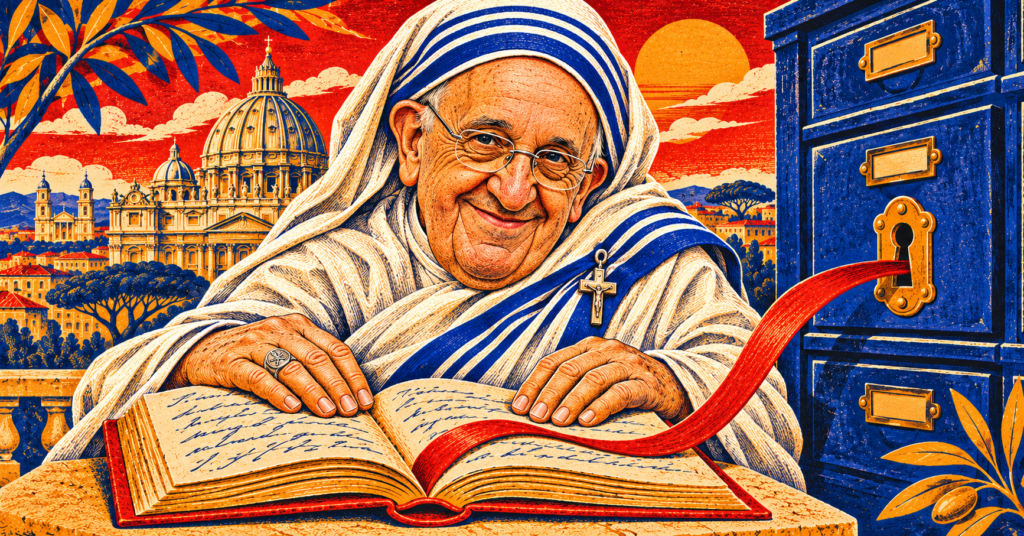
From Bergoglio’s diary to Leo XIV’s journey: memory, power, and what the Vatican leaves out. Are they turning Bergoglio into another Mother Teresa to pave the way for the new Augustinian theology? (italian)
A single thread runs through these pages: the gap between what the Vatican says and what it does. The old saying about failing to practice what you preach is hardly an insult. Sadly, it has become a familiar refrain for anyone who follows the Vatican day by day. It applies to seventy-five years of selective silence, to the double standard in Church discipline under recent popes, and now to a publishing venture that gives the public a Francis carefully fashioned for posterity. The aim is to make him another Mother Teresa of Calcutta, preparing the way for a new Saint Augustine and a new Catholic-Islamist theology. One sets the pace for the other’s final sprint. All in vain.
A method with a long history
Catholic teaching on communism was unequivocal: Pius XI’s Divini Redemptoris, the Holy Office decree of July 1, 1949, and excommunication. Yet the Church showed little of the same resolve when it came to naming the executioners or denouncing individual massacres, in Italy or behind the Iron Curtain.[1] The condemnation struck at the ideology and left those responsible unnamed. Indiscriminate excommunication wounded rank-and-file communists who still held to the faith and left the party machinery intact. In that disparity under Pius XII—repaid in venom by Jewish communists[2]—between solemn doctrine and veiled judgment, one can discern a gentle way of practicing apostasy.
John XXIII made it a program. At the opening of the Council on October 11, 1962, the Church chose to “use the medicine of mercy instead of taking up the weapons of severity.” Six months later, Pacem in terris distinguished “false doctrines” from the historical movements they had inspired and acknowledged that those movements might contain “positive elements.” In those same months, the Holy Office was tightening restrictions on Padre Pio.[3] Paul VI gave the method institutional form. Ecclesiam suam made dialogue central to how the Church engaged the world. Casaroli’s Ostpolitik put it into diplomatic practice. Cardinal Mindszenty, forced against his conscience to relinquish the see of Esztergom, paid the price.[4]
This fell short of formal apostasy. The Creed remained intact. What changed was the order of precedence, in practice, between truth and dialogue. Doctrine stayed in the archives. Political relationships shaped the conduct of affairs. Dio è Onnipotente calls this “a slippery kind of apostasy,” a historical and theological judgment on the method, distinct from a charge under canon law.
The pattern recurs today, though the party across the table has changed. Communism and political Islamism are different. The Church’s response is the same: multiply symbolic gestures, soften judgments, and say nothing about the reciprocity that John Paul II and Benedict XVI set as a standard for relations with the Islamic world.[5] The communications strategy follows Willi Münzenberg’s familiar playbook. An outright lie is hardly necessary when one can decide what the public sees, select the facts, and shift the frame.[6]
2. A double standard in Church discipline
The decisions themselves put that judgment to the test. Under Francis and Leo XIV, declarations of excommunication have chiefly targeted traditionalist or schismatic positions. Among those affected were Father Minutella (2018), the Poor Clares of Belorado (2024), Archbishop Viganò (July 2024), the bishops of the Society of Saint Pius X consecrated at Écône and the bishops who consecrated them (decree of July 2, 2026, signed by Cardinal Fernández), and Father Leonardo Maria Pompei (September 2026). Only two cases involved progressive positions or personal conduct. In one of them, Rupnik’s, the penalty was lifted that same month and disclosed only two and a half years later.[7]
Over the same period, more Catholic spaces have been made available for Muslim worship, and joint religious observances have become more frequent. The gestures range from prayer in the Sistine Chapel with Charles III, Supreme Governor of the Church of England (October 23, 2025), to Leo XIV’s pause before the mihrab, the prayer niche in the Great Mosque of Algiers (April 13, 2026). During his September 2026 trip to France, as the country enacted the euthanasia law championed by Macron with the votes of Catholic lawmakers among others, the pope spoke of life and dignity. He announced no pastoral or canonical measures concerning those who had advanced the law.[8]
The faithful over whom Church authorities exercise direct control bear the brunt of that severity. Political authorities receive words of admonition. That is what failure to practice what one preaches looks like when it becomes a method of government.
3. Bergoglio’s diary and the making of his public memory
It was against this backdrop that Il diario personale di Papa Francesco (The Personal Diary of Pope Francis) appeared on November 24, 2026. Published by the Vatican press, Libreria Editrice Vaticana, the book was presented to international publishers at the Frankfurt Book Fair and distributed in five languages across 94 countries.[9] Its author is the prefect of the Dicastery for the Doctrine of the Faith and was Bergoglio’s closest theological collaborator for more than twenty years.
The book itself documents Leo XIV’s part in its making. Fernández recounts that, some months after the election, he asked the new pope for permission to study Francis’s writings. Leo “showed interest” and a few days later sent him the box containing them.[10] Without that handover there would be no book. The book, in turn, pays tribute to the man who supplied it. Among the compliments Francis is said to have paid his associates, it credits the late pope with calling Prevost “a great pastor, a generous missionary, and a man beyond reproach.”[11] The editor includes this unverifiable oral testimony in a book made possible by the very man it praises.
A critical reading of the book shows what the undertaking amounts to. The diary accounts for roughly 15 percent of the text, some 4,000 words out of 25,000, drawn from 141 manuscript pages. Readers get no facsimile, no Spanish text, no statement of transcription principles, and no translator’s name. A stock phrase disposes of the passages in code: “We neither can nor should decipher them.” The numbers belie the claim that the book presents “most” of the diary. The only warrant offered for publication is a remark that leaves the matter open: “As for that, you’ll see to it.”[12] Some dates do not square with the record. The notes on Fátima are dated October 2023, although Francis visited Fátima on August 5. The words “Today, the feast at St. Mary Major,” a feast that falls on August 5, are attributed to a letter dated March 31, 2000.[13]
What the commentary takes away is more telling still. In the entries for 2021–22, the diary speaks of a “puppet master who knows his trade,” of “different ways of buying,” and of “problems of governance, pressure to make decisions.” Fernández concludes that the matter “was more internal than external.” He never sets those words alongside the acts of governance of those two years: Traditionis custodes, the Becciu trial, Ad charisma tuendum, and the intervention in the Order of Malta.[14] Of Chile, the diary admits, “I didn’t think it was that serious.” The commentary treats the episode as a source of spiritual weakness. It passes over what was at issue: the cover-up of abuse by a bishop the pope had appointed and defended.[15]
A second reading, more generous to the editor, reaches the same conclusion by another route. The book is at its best where the papers “resist the portrait into which they have been gathered.” Its limits show when the quality of a man’s prayer becomes the measure of his government.[16] The two readings also agree on a point of chronology. The claim that Francis read Voillaume “no earlier than 2023” does not hold up. He could have read a November 2022 reprint in the closing weeks of that year, close to the “rebirth” dated December 30.
4. From remembrance to the altar
The book reads like a life written with canonization in view.[17] Petitions are tucked beneath a statue of the sleeping Saint Joseph, who is said to have granted “most” of them. White roses from Saint Thérèse serve as a “seal.” There are three bodily apparitions of the devil, a vision of the entrance to hell, and dreams interpreted as divine messages. In May 2024, the very dicastery Fernández heads issued rules urging extreme caution in discerning supernatural phenomena. Here those phenomena appear without scrutiny, on the authority of the Vatican’s publishing imprint.
Public calls to begin the process of beatifying Francis began around the first anniversary of his death, in April 2026.[18] As of this writing, no cause appears to have been opened. Fernández’s book assembles the material in advance: signs, evidence of humility, and a reading of self-reproach as proof of holiness. Whether a “new Mother Teresa of Calcutta” will emerge is an open question. That the book prepares the ground is apparent from the kind of life it tells.
The same pattern emerges in the making of the successor’s public image. Prevost is an Augustinian. The book has Francis call him “a man beyond reproach.” Biographies published since the conclave dwell on the pastor who stood close to victims. It would be premature to call this canonization in advance. What we can see is the systematic production of a portrait without shadows, one that absorbs the controversies and leaves them unresolved.
5. Argentina: the talk and the record
In his twelve years as pope, Francis never returned to Argentina. No official reason was ever given. The explanation heard most often in the Argentine press is that he feared being used by opposing political camps and by the Casa Rosada, Argentina’s presidential office.[19]
Human rights organizations were hostile to Bergoglio for years. In 2002, as archbishop, he tried to stop the Mothers of the Plaza de Mayo, led by Hebe de Bonafini, from staging a protest in the Metropolitan Cathedral.[20] The press accused him of complicity in the kidnapping of the Jesuits Jalics and Yorio and of collaboration in the case of Ana Libertad, a granddaughter taken from her family.[21] Until his death in 2000, Orlando Yorio maintained that their Jesuit provincial had effectively handed them over to the death squads by publicly withholding his support.[22]
After the conclave the picture changed, and the speed of the change deserves attention. On March 15, 2013, two days after the election, Father Franz Jalics said he “could not comment on Father Bergoglio’s role” in those events. On March 20, five days later, he clarified: “Bergoglio did not denounce Orlando Yorio or me.”[23] That second statement contradicted what Jalics had previously told Horacio Verbitsky, who acknowledged after the denial that his accusations rested on “inferences.”[24] Yorio was dead. He could issue no correction.
On May 27, 2016, Hebe de Bonafini was received at Santa Marta and publicly asked for forgiveness. “We were wrong about him, just as we were about Néstor Kirchner.” She said she had come to tell the pope about the situation in Argentina “so he can give us a hand.”[25] The following year, the day after she was ordered to stand trial in the Sueños compartidos case, she released a letter in which the pope compared her to Jesus facing slander.[26] The retractions hardly came out of nowhere. They followed the election, coincided with an interest on the part of those retracting in having the pope on their side, and found a receptive audience in the Holy See’s diplomatic corps, attentive to the pontiff’s reputation. The chronology is consistent with the possibility that Bergoglio’s new standing helped bring public statements into line.
Bringing public statements into line, however, is no guarantee of a welcome at home. Francis never returned to Argentina in his twelve years as pope, despite invitations from four presidents and, in 2017, from Bonafini herself.[27] The Argentine press most often cites fear of being used by the Casa Rosada.[28] That leaves room for another explanation: the pope may have known he could hardly count on a unanimous welcome at home. Part of the country, remembering the dictatorship and accusations never resolved in court, may have been ready to greet him with open hostility. His refusal to return is a matter of record. His reason, which he never gave, remains a matter of inference.
On one point Fernández’s book makes the question unavoidable. A volume promising “the most authentic Bergoglio” devotes not a line to 1973–83, the decade that included his years as Jesuit provincial under the dictatorship. The diary begins in 1992. The commentary describes 1986–92 as “the years when I was a refugee” and speaks of his “expulsion” from the Jesuit residence. Yet it never explains his conflict with the Society of Jesus, whose roots lie in that earlier decade.[29] Argentina under the dictatorship is the book’s largest silence. It is the same silence that followed Francis to his death, far from home.
Set that against the events of November. On November 8, 2026, Leo XIV arrived in Argentina, the first pope to visit since John Paul II in 1987. President Milei met him at the airport.[30] On November 9, in the Buenos Aires cathedral where Francis had served as archbishop, Leo paid tribute to him.[31] Fifteen days later the diary was published worldwide. The successor made the journey his predecessor had declined to make and honored his memory in the place Francis had avoided. The Vatican then published its spiritual portrait of the late pope. The sequence is documented. That the events were coordinated is a reasonable inference.
6. Chiclayo: the return and the shadow it casts
Leo XIV was in Peru from November 11 to 16. On November 13 he returned to Chiclayo, the diocese he had led for eight years, and celebrated Mass on the Pampas de Pimentel before more than a million worshippers, according to the Peruvian press. On November 14, in his former cathedral, he crowned the image of the Immaculate Conception.[32]
The case of the Quispe sisters hangs over that same diocese. In April 2022, three women told Bishop Prevost that two priests, Eleuterio Vásquez Gonzáles and Ricardo Yesquén, had abused them when they were minors. The women say that no effective investigation began and that the accused priest continued to celebrate Mass. The diocese has consistently disputed their account, saying that Prevost ordered a preliminary investigation and sent its findings to the Dicastery for the Doctrine of the Faith on July 21, 2022.[33] Prevost’s successor, the Augustinian Edinson Farfán, was appointed in February 2024 while Prevost headed the Dicastery for Bishops. Farfán acknowledged that the case had been mishandled and opened a new investigation. He later publicly defended his predecessor’s actions.[34] One of the women subsequently voiced doubts about her own lawyer’s intentions.[35]
In an interview included in Elise Ann Allen’s biography, Leo XIV himself said he had tried to “understand and be close to” the victims. He deplored the slowness of the Church’s justice system: “Honestly, I feel very bad about that.”[36]
The parallel with Francis lies in the way each man answered. Of Chile, Bergoglio wrote in his diary, “I didn’t think it was that serious.” Of Chiclayo, Prevost says, “I feel very bad.” In each instance a pope acknowledges a delay in the abuse case most closely bound up with his own past. In each, the acknowledgment stops at a statement of feeling. The public still lacks an account of who decided what, when, and why. This article neither establishes individual culpability nor claims to do so. What the record does establish is the form of the response: regret in place of an accounting.
7. An irreversible crisis?
The evidence points in one direction. The postwar method has gone uncorrected. Its reach has grown from communism to political Islamism, from diplomacy to internal discipline. The accounts remain secret. The Holy See’s sudden return to surplus in 1993, after twenty years of deficits and in the midst of the lira’s devaluation, has never received a documented explanation.[37] The files on Emanuela Orlandi, the Institute for the Works of Religion (the Vatican bank), pressure on conclaves, and Benedict XVI’s resignation remain closed. Excommunications fall on those who challenge papal authority. Those who offend against life escape them. The successor leaves his predecessor’s archives closed and entrusts his memory to his closest collaborator, who gives it back to the public as a defense of the man.
Judged by human means alone, nothing points to a reversal. Yet “irreversible” has no place in the vocabulary of faith, as the writings summarized here explicitly say. The Vatican and the Church are two different things. Griselda stands firm against the husband who pretends he means to destroy her. Abraham, the Jew in the Decameron, sees a corrupt Curia in Rome and converts for that very reason: a religion that survives such administrators must have the Holy Spirit to sustain it.[38] It is the institution that is in crisis. The Church belongs to God, “His and no one else’s.”
That gives us a standard by which to judge what happens next. The Vatican cannot talk its way out. Every new pronouncement, encyclical, journey, or book will be measured against the facts. We know what would make a genuine purification possible to verify: open the sources, name the victims and their persecutors, judge conduct by public standards that apply equally to everyone, account for the money, and correct the practices.[39] For Francis’s diary the requirements are equally specific. Deposit the original in a public archive. Publish it in full with the Spanish on facing pages. Reproduce the pages quoted, identify what was omitted, and correct the erroneous dates.[40]
Conclusion
Bergoglio’s diary and Leo XIV’s journey are part of the same undertaking. The successor and the circle both men served manage the predecessor’s memory, while questions about how they governed go unanswered. Francis appears as a mystic of mercy, his successor as the pastor beyond reproach whom that mystic had recognized. Chile and Chiclayo, the two cases that bring each pope face-to-face with his responsibility for decisions made under his authority, are reduced to expressions of feeling.
Talk is still talk. Fernández’s book, the Mass in Chiclayo, the tribute in the Buenos Aires cathedral: these are words and images. The facts lie elsewhere, in the coded papers no one can read, the canon law files no one publishes, the financial statements no one sees. As long as those records stay closed, each new word from the Vatican will carry less weight than the last.
[1] Dio è Onnipotente, chapters “Depositum Fidei” e “Pio XII: morale asimmetrica”; Sei storie taroccate, chapter “La Togliattizzazione dell’Italia”, § 6.
[2] Radio Moscow made the first public accusation in early June 1945. Hochhuth came eighteen years later. The trigger was Pius XII’s June 2, 1945, name-day address to the cardinals, in which he condemned the “satanic specter” of Nazism. Radio Moscow answered immediately. On June 3 it proclaimed Pius XII “Hitler’s pope.” Father Giovanni Sale’s research in La Civiltà Cattolica identifies the June 7 broadcast as decisive. In Sale’s words, it “became paradigmatic” because it summed up the radical left’s view of the Holy See’s wartime activities. The shift from propaganda to “culture” came in 1951 with “Il Vaticano e il problema ebraico,” by the Jewish author Léon Poliakov.
[3] Dio è Onnipotente, chapter “Giovanni XXIII: la svolta,” including the chronology of measures taken in 1960–64 (the Maccari visitation, Ottaviani’s letter of January 31, 1961, the directive of April 24, 1961, and its revocation on January 30, 1964).
[4] Dio è Onnipotente, chapter “Paolo VI: dal metodo alla struttura”.
[5] Dio è Onnipotente, chapter “Dal comunismo all’islamismo: il riflesso dell’accomodamento”.
[6] Sei storie taroccate, chapter “Willi Münzenberg”, §§ 10-12.
[7] Dio è Onnipotente, “Specchio cronologico. Scomuniche e ospitalità interreligiose nei pontificati di Francesco e Leone XIV (2013-2026)”.
[8] Dio è Onnipotente, chapter “Francia, scomuniche e onori: la prova della coerenza”.
[9] Avvenire, October 5, 2026; Vatican News, October 2026.
[10] V. M. Fernández, Il diario personale di Papa Francesco, LEV, Vatican City 2026, pp. 10-11.
[11] Ibid., p. 73.
[12] Critica ragionata, §§ 1 and 3; Fernández, Il diario personale di Papa Francesco, pp. 8, 10-11, 15.
[13] Critica ragionata, § 4.
[14] Critica ragionata, § 6; Fernández, Il diario personale di Papa Francesco, pp. 67-71.
[15] Fernández, Il diario personale di Papa Francesco, p. 69; Critica ragionata, § 8.
[16] Il diario e il suo interprete, concluding paragraph.
[17] Fernández, Il diario personale di Papa Francesco, pp. 28-30, 52-63.
[18] il Giornale, April 2026; ACTS Social, April 22, 2026.
[19] Expansión, April 22, 2025; EJU, April 2025; Ámbito, April 2025.
[20] IHU Unisinos, November 22, 2022.
[21] La Izquierda Diario, May 17, 2017.
[22] The Philadelphia Inquirer/AP, March 21, 2013.
[23] Statements by F. Jalics on the German Jesuits’ website, March 15 and 20, 2013. Avvenire, March 21, 2013. The Philadelphia Inquirer/AP, March 21, 2013.
[24] Democracy Now!, March 28, 2013; Avvenire, March 21, 2013.
[25] Infobae, May 27, 2016.
[26] La Izquierda Diario, May 17, 2017; IHU Unisinos, November 21, 2022.
[27] Ámbito, April 2025; La Izquierda Diario, May 17, 2017.
[28] EJU, April 2025; Expansión, April 22, 2025.
[29] Fernández, Il diario personale di Papa Francesco, pp. 102-103; Critica ragionata, § 8.
[30] EFE, November 8, 2026; Vatican News, November 2026; Ámbito, August 5, 2026.
[31] Última Hora, September 23, 2026.
[32] El Peruano, November 13, 2026; EWTN News, November 14, 2026; La Patilla/EFE, November 14, 2026.
[33] National Catholic Reporter, 2025; Bishop-Accountability, 2025; statement by the complainants, September 11, 2025.
[34] Bishop-Accountability, 2025; ACI Prensa, 2025.
[35] National Catholic Reporter, article “Exclusive: Pope Leo critic now says her lawyer might have had secret agenda”.
[36] ACI Prensa, September 2025, on the interview in E. A. Allen, León XIV: ciudadano del mundo, misionero del siglo XXI, Penguin, 2025.
[37] Dio è Onnipotente, chapter “Segreto, falso, inganno e perfidia in Vaticano”.
[38] Dio è Onnipotente, Prologue.
[39] Dio è Onnipotente, table “Verità, disciplina e purificazione”.
[40] Critica ragionata, § 13.
